Serving as a psychologist during the Solomon Islands for Christ initiative highlighted the island nation’s need for accessible counselling services, as young people approached me to disclose experiences of trauma, abuse and difficult home situations—some for the first time.
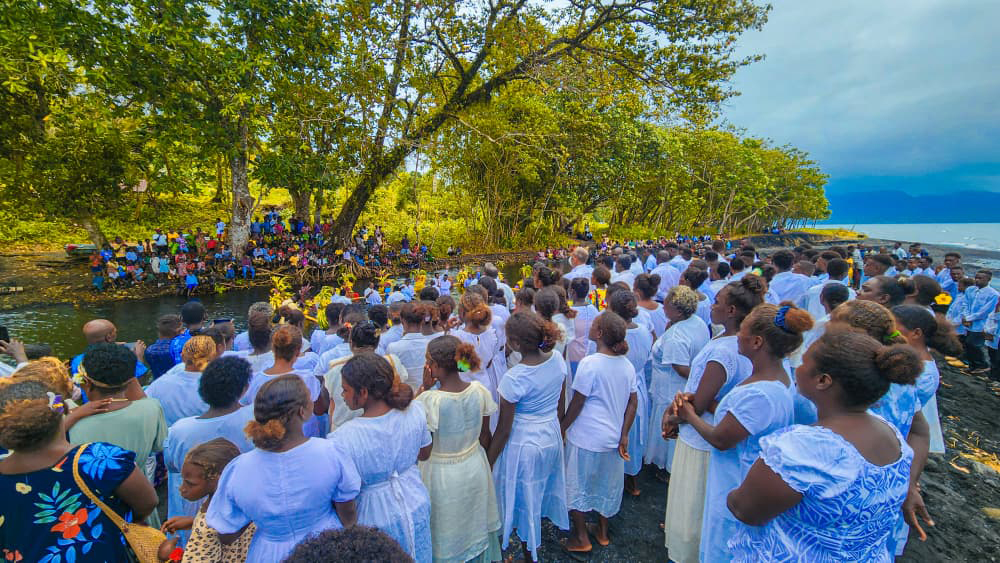
I joined my husband, Pastor Nathan Andreoli, at a site in a rural community during Solomon Islands for Christ, held from July 5 to 18. While my husband presented the evening Bible messages, I delivered mental health talks addressing some of the personal and emotional challenges experienced by people in the community.
I was there to open the heart and then my husband opened the Word. We’ve found from past trips that when we use this format, it helps people become more open because we’re touching on the issues of the heart. I really believe in that model. As we’ve followed it, people have shared with both Nathan and I that they’ve been to evangelistic meetings before, but no-one had ever spoken about the things they were carrying in their hearts every day. They told us this felt different. I don’t say that because I think mental health education should replace the Gospel—quite the opposite. I believe mental health support and education can help remove some of the emotional barriers that stop people from hearing the Gospel. When people feel understood and safe, they often become more open to hearing about God’s love.
During my presentations and in my private conversations, I encountered concerns including substance use, violence, bullying, anxiety and depression. Some young people described using alcohol or other substances due to peer pressure or to deal with challenging home situations. There is a lot of violence and mistreatment. A lot of people are self-medicating with drugs, and drugs are so easy to get. Anxiety and depression are common, as they are in Australia, but there is less education here about what is going on.
Before beginning the program, I contacted Solomon Islands Mission health director Dr Chester Kuma to identify services to which I could refer people requiring further assistance. I discovered that formal mental health care was largely focused on people experiencing severe psychiatric conditions, while opportunities for general, ongoing counselling were limited. Regarding actual ongoing counselling, there’s almost nothing.
World Health Organization data illustrates the scale of the challenge. Its 2020 country profile, published in 2022, recorded 14 mental health professionals serving a population of almost 670,000 people. These included two psychiatrists and nine mental health nurses, but no psychologists, social workers or workers dedicated specifically to child and adolescent mental health. The country profile also recorded one mental hospital and limited integration of mental health care into primary health care. In 2026, the Solomon Islands population is nearly 860,000, meaning that the actual picture, while murky, is also likely more dire than the 2020 estimate.
Specialist support is available through organisations including the Family Support Centre, which provides confidential counselling and case management for survivors of violence, the Seif Ples Crisis and Referral Centre and the Anglican Church of Melanesia’s Christian Care Centre. However, these services primarily support people experiencing domestic or sexual violence rather than provide broad access to continuing psychological care.
Trust developed between me and local people after I spent a week discussing mental health publicly, sharing appropriate parts of my own experience and repeatedly inviting people to speak with me privately. Although people were not always culturally accustomed to discussing personal struggles openly, they began approaching me with experiences they had kept secret for years. Many of them shared things they had never shared with anyone before because we had taken the time to open our hearts to them first. Several young women and girls disclosed experiences of childhood sexual abuse or other trauma. One told me that she had been praying for God to send someone she could trust enough to tell. This did not just happen once. It happened multiple times.
After listening, I reassured those who had experienced abuse that they were not responsible for what had happened and did not need to carry its shame. I asked one person, “How are you feeling now that you’ve told someone?” They sighed with relief and said, “I just feel so free now.” It shows the power of someone being able to share their story with a person they know is safe, who is there for them and who will keep it confidential.
A big part of what I did each night wasn’t just counselling, it was providing simple mental health education. We talked about the brain, its different parts, trauma, anxiety, depression and why our brains respond the way they do.
One woman came up to me after one of the talks seeking counselling. The talk was on trauma education and she realised this might be what she was experiencing. She had recently escaped a long-term abusive relationship and kept saying, “My brain isn’t working.” She told me she had reached the point where she wanted to take her own life because she thought this was how she would be forever.
After asking some questions, I realised she had all the symptoms of post-traumatic stress disorder (PTSD). I was able to explain that what she was experiencing was actually a post-traumatic stress response. We went through each of her symptoms and why they were happening. For the first time, she understood that she wasn’t “broken” or going crazy, but that her brain had adapted to survive trauma. The beautiful part was being able to tell her that brains heal. She genuinely thought there was no hope and that she would feel this way for the rest of her life. By the end of our conversation, she had a smile on her face and told me she felt hope for the first time again. To me, that’s the power of mental health education. It’s not only about hearing someone’s story, but also about helping people make sense of their story.
The final message I left our Solomon Islanders with was: “God cares about your faith and your beliefs, but He also cares about your heart.”
As Adventists, we say no to violence. We strongly believe in the value of each person and their right to safety. August 22 is enditnow Emphasis Day. enditnow is a global initiative that aims to mobilise Seventh-day Adventists and other community groups worldwide to raise awareness and advocate for the end of violence around the world. To learn more, go to enditnow.org or in Australia, enditnowaustralia.org.au.
Maria Andreoli is a psychologist who is based in Cooranbong, NSW.