Faith seldom develops in isolation. Rather, it is shaped, stretched and strengthened within a context—a unique environment marked by specific challenges, tasks and relationships.
Throughout the biblical narrative, God consistently calls individuals into service not apart from real-life situations, but within them. It is within these contexts that people grow in their faith, confront their limitations and come to rely more fully on God’s power and providence.
Take Moses, for instance. When God called him from the burning bush (Exodus 3:1–12), it was within the context of Israel’s bondage in Egypt. His calling was not just to lead the Israelites out of slavery, but to engage in a divine process through which both he and the people would grow. Moses, once reluctant and insecure about his speech (Exodus 4:10), became a man who would later speak with God “face to face, as a man speaks to his friend” (Exodus 33:11, NKJV).
Similarly, Esther’s rise to the throne came during a politically volatile time. Her cousin Mordecai discerned the divine context when he told her, “Yet who knows whether you have come to the kingdom for such a time as this?” (Esther 4:14, NKJV). It was in that very moment of tension and risk that Esther’s courage and faith were refined.
In the New Testament, the calling of the disciples occurred within the context of Roman occupation, religious tension and social unrest. As Jesus sent them out, they were shaped by the very mission they undertook. Peter, whose name in Greek (Petros) signifies a rock, became a foundational figure in the early church—not because he was perfect, but because, within the context of his calling, God shaped him.
A modern example: Two churches, one mission
A modern expression of this biblical principle can be seen in the journey of Garden City Fellowship Seventh-day Adventist Church and Aranui Seventh-day Adventist Church, both located within the South New Zealand Conference. These congregations, while sharing the same Adventist faith, had developed distinct cultural expressions of worship and community outreach.
Garden City Fellowship embraced a contemporary, multicultural worship style, while Aranui maintained a more traditional and community-rooted approach.
For years, the unspoken assumption remained—that congregations with such different identities could not fully integrate or worship together as one. This is a myth that echoes in many church communities: that cultural or stylistic differences are too great to be reconciled.
But God had other plans. Through a church building project, God provided a shared context for transformation.
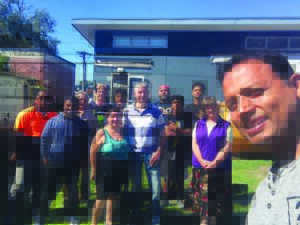
Bringing two congregations together in one place and under one vision was not without difficulty. Challenges arose in decision-making, cultural expectations and financial pressures. But even more powerfully, something beautiful began to unfold. During the building project, members from both churches came together for practical tasks: weeding the overgrown gardens, fencing, clearing rubbish, painting walls and restoring the once-neglected land. These were not glamorous tasks, but sacred ones. As hands got dirty and tools were passed around, something invisible but real began to take root—unity, trust and genuine love for one another and for God.
They shared meals in between the work, laughed at one another’s jokes and encouraged each other when exhaustion set in. Walls came down—not just physical ones, but relational and cultural ones. Through sweat and service, they began to see each other not as two congregations but as one body of Christ. As Jesus declared, “By this all will know that you are My disciples, if you have love for one another” (John 13:35, NKJV).


A witness to the power of context
In time, the two churches officially became one: Aranui Garden City Seventh-day Adventist Church. The transformation of the building became symbolic of the transformation happening within hearts. The context of building the church was not an interruption to faith but the very arena in which faith matured.
Their story stands as living proof that with God, even the seemingly impossible becomes reality (Matthew 19:26, NKJV). The myth that different congregations cannot function as one is shattered when God is the one doing the uniting. Like the early church in Acts 2:44–47, this newly united congregation experienced the joy of “having all things in common”, and they saw God add to their numbers—not just in membership, but in love, maturity and mission.
The call for today
This journey reminds us that God’s call often comes through the very context we might try to avoid. Whether through rubble and renovation, cultural differences or the challenges of cooperation, God uses the context of mission to shape us. As the apostle Paul affirms in Philippians 1:6, “He who has begun a good work in you will complete it until the day of Jesus Christ” (NKJV). When we respond to God’s call and engage with the context He places us in, we not only grow ourselves, but we help others grow with us.
Let us, therefore, embrace the call—not waiting for the perfect conditions, but trusting in the God who helps us through the process. In the context of calling, faith is forged and communities are made one—for the glory of God.
Younis Masih is a minister at Aranui English/Garden City Fellowship in New Zealand.