Carry each other’s burdens, and in this way you will fulfil the law of Christ” (Galatians 6:2).
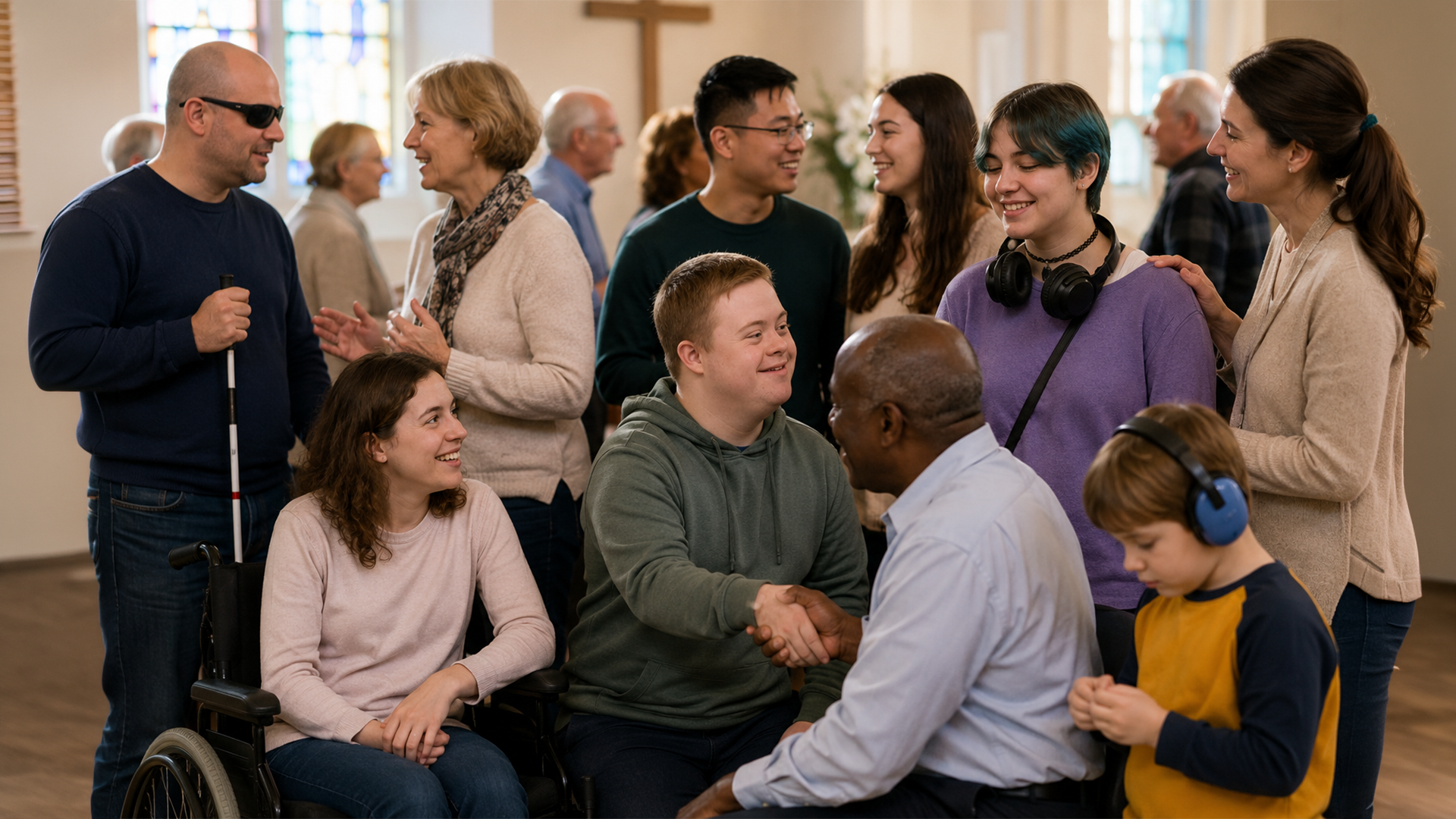
Disability is not a marginal issue. It does not exist “out there” in the wider community while remaining absent from our churches. It is present in our pews, our families, our schools, among our friends and neighbours, and in our congregations. The question before us is not whether people with disabilities belong in the church but whether the church is willing to fully belong to them.
In Australia today, more than one in five people live with disability.1 Within the Seventh-day Adventist Church, this translates to thousands of members, many with visible disabilities, many with disabilities that are not obvious to the naked eye. And yet, for too many, church remains a place of partial inclusion: attended, but not fully accessible; present, but not fully welcoming; cared for, but not truly needed.
What do we mean by disability?
Disability is often misunderstood as a narrow category defined only by visible impairment. In reality, disability encompasses a wide range of physical, sensory, intellectual, neurological and psychosocial conditions. It may be present from birth, develop over time or fluctuate throughout life. Importantly, disability is not only about a person’s body or mind but also about environmental and attitudinal barriers.2,3
We recognise that a wheelchair user is not disabled solely by their body but by a building with stairs and no ramp. A child with autism is not disabled only by their neurology but by an environment that overwhelms the senses. A person who is deaf is not disabled merely by hearing loss but by the absence of accessible communication. In each of these cases, exclusion is not inevitable; it is constructed. As a body of Christ, we must ask ourselves: how do these examples reflect the realities of our church on Sabbath morning? How might our practices, our spaces and our words unintentionally erect barriers to the full participation of all God’s children? And then, led by the Spirit, we can seek to remove those barriers, embodying the inclusive love of God that welcomes everyone to the table.
Historical and theological barriers
Some of the most persistent barriers faced by people with disabilities are not physical, but theological. Historically, disability has often been interpreted through what scholars describe as the religious model of disability,4 which is the belief that disability is a punishment for sin, whether personal or generational.
This way of thinking has deep roots. Scripture contains examples where illness appears connected to disobedience, such as King Uzziah’s leprosy (2 Chronicles 26:16–23). There are also biblical accounts of people with disabilities being excluded from full participation in religious life (2 Samuel 5:8). Over time, these narratives shaped assumptions that disability signalled divine displeasure. Jesus decisively rejected this interpretation. When asked who sinned to cause a man to be born blind, Jesus replied, “Neither this man nor his parents sinned, but this happened so that the works of God might be displayed in him” (John 9:3). Disability, He made clear, is not evidence of moral failure. It is not punishment from God but a consequence of living in an imperfect world. This distinction matters. When disability is framed as punishment, people are marginalised, pitied or treated as projects rather than as full members of the body of Christ.
Made in the image of God
Scripture affirms that every person is created in the image of God (Genesis 1:27) and “fearfully and wonderfully made” (Psalm 139:14). This truth does not exclude people with disabilities; it explicitly includes them. Disability does not diminish a person’s worth, calling or capacity to reflect God’s image or fulfil God’s calling for their lives.
Yet societal attitudes often suggest otherwise. Even within faith communities, people with disabilities may be welcomed as recipients of care but overlooked as contributors, leaders or decision-makers. Belonging requires more than kindness; it requires recognition, responsibility and relationship.
A 2021 study5 examining the experiences of adults with disabilities in the Seventh-day Adventist Church in North America found that while many felt cared for by pastors and teachers, they often felt overlooked by congregations as a whole. More significantly, participants reported that true belonging was tied not only to care, but to being needed, to having meaningful roles and responsibilities within church life. Encouragingly, the global church has taken steps forward through initiatives such as Adventist Possibility Ministries,6 signalling growing awareness and commitment. Still, there is more work to be done.
Jesus and restored dignity
Jesus’ ministry consistently challenged exclusion. When He healed those with disabilities, He did more than restore physical function. He restored dignity and belonging.
In Matthew 21, Jesus healed the blind and the lame in the temple itself—a space from which they had long been excluded. This act provoked outrage among religious leaders, not simply because healing occurred, but because it disrupted deeply embedded boundaries. Jesus made it clear: God’s presence is not reserved for a select few. Everyone belongs where God dwells.
Practising “Do No Less”
What, then, does faithfulness look like today?
First, advocacy. Proverbs 31:8,9 calls believers to speak up for those whose voices are unheard. Advocacy may involve addressing accessibility barriers in church buildings, supporting disability organisations or speaking with church leaders about unmet needs.
Second, relationship. People with disabilities are not ministry projects. They are neighbours, friends and family members. Scripture offers a powerful example in Mephibosheth, who was disabled as a child after being dropped while fleeing for safety (2 Samuel 4:4). King David welcomed him into his household, granting him a permanent place at the king’s table (2 Samuel 9). Belonging, not fixing, was the gift.
Third, recognition. Throughout Scripture, God explicitly names people with disabilities in His promises (Leviticus 19:14; Jeremiah 31:8). Their inclusion is not an afterthought; it is intentional.
Finally, reframing weakness. Moses, who struggled with speech, and Paul, who spoke of a persistent “thorn”, remind us that God’s power is made perfect in weakness (Exodus 4:10–12; 2 Corinthians 12:9). Disability does not disqualify a person from God’s purposes; it often reveals them more clearly.
A call to the church and to YOU!
Disability is not a future issue but a present reality. As Australians age, most will experience some form of disability over their lifetime. The church is called not merely to respond, but to lead: to model a community where every person is welcomed, valued and empowered.
Ellen White captured this responsibility powerfully:
“I saw that it is in the providence of God that widows and orphans, the blind, the deaf, the lame and persons afflicted in a variety of ways, have been placed in close Christian relationship to His church; it is to prove His people and develop their true character. . . If we have the true religion of the Bible, we shall feel that a debt of love, kindness and interest is due to Christ in behalf of His brethren; and we can do no less than to show our gratitude for His immeasurable love to us while we were sinners unworthy of His grace, by having a deep interest and unselfish love for those who are our brethren, and who are less fortunate than ourselves” (Testimonies for the Church, vol 3, p511).
The challenge before us is clear. To follow Christ faithfully is to refuse exclusion, to resist harmful narratives and to build communities of genuine belonging.
As a church, may we commit to doing no less.
- Australian Bureau of Statistics, Disability, Ageing and Carers, Australia: Summary of Findings, 2022, <abs.gov.au>. ↩︎
- Australian Human Rights Commission, Know your rights: Disability discrimination, <humanrights.gov.au>. ↩︎
- Australian Institute of Health and Welfare, People with disability in Australia, <aihw.gov.au>. ↩︎
- Katrona Templeton, “Spiritual and Biblical View of Disabilities”, Ascend/Church of Scotland, November 2021, <ascend.churchofscotland.org.uk/2021/11/spiritual-and-biblical-view-of-disabilities-by-katrona-templeton/>. ↩︎
- recartin, Shannon; Wile, Mikelle; Trecartin, Terrance; and Činčala, Petr, “Being Needed, Cared for, and Present: Belonging and Disability in the Seventh-Day Adventist Church in North America” (2021). Faculty Publications. 4201, <digitalcommons.andrews.edu/pubs/4201>. ↩︎
- Adventist Possibility Ministries, “About Us”, accessed January 10, 2026, <adventistpossibilityministries.org/>. ↩︎
Dr Dawn Grant-Skiba is the principal of a small specialist school in Sydney, supporting students with profound disabilities. This article is adapted from a sermon she delivered at Campbelltown church (NSW) in December 2025. Married to Pastor Charles Grant-Skiba, an aged-care chaplain within the Seventh-day Adventist system.