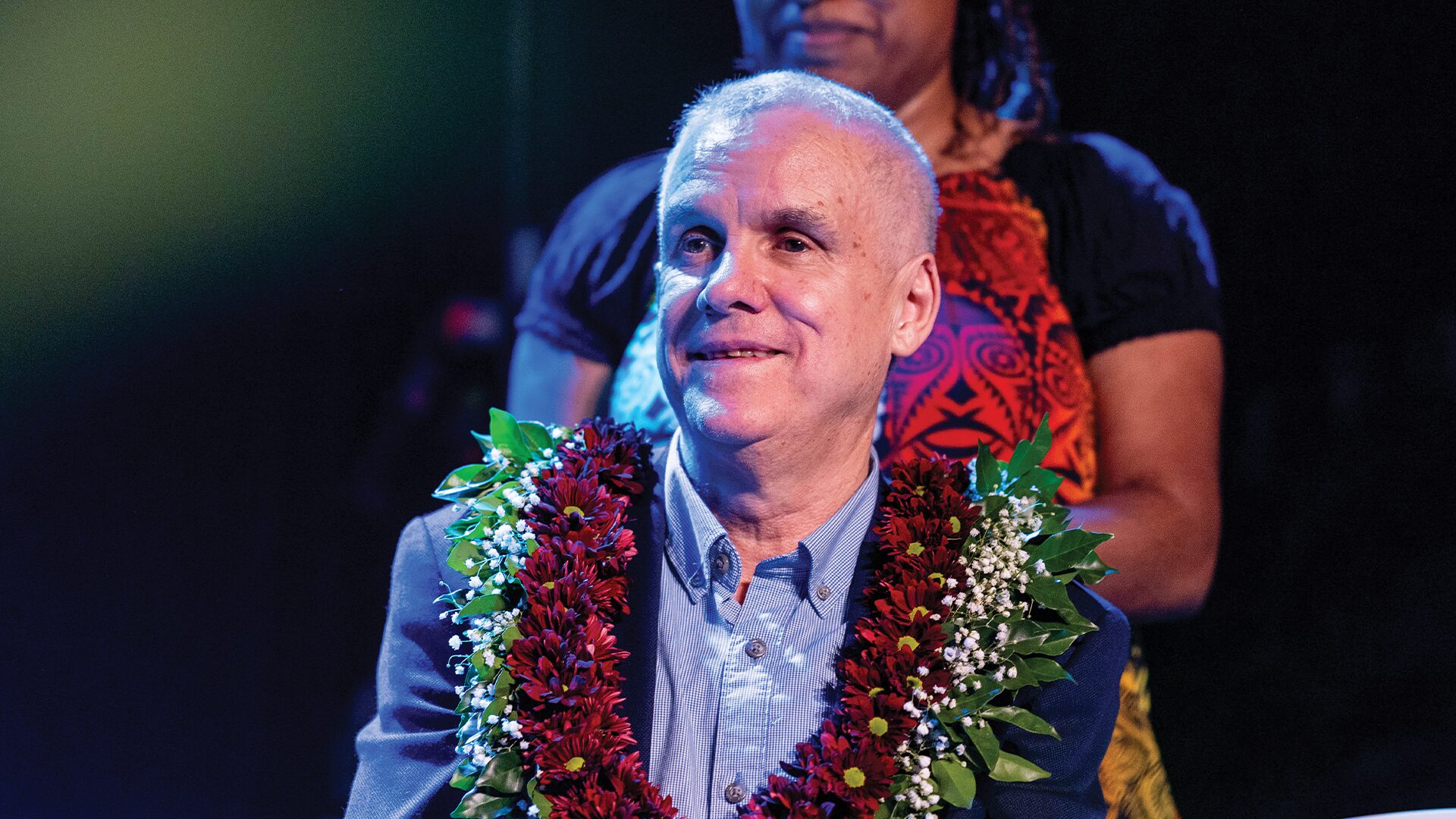
During the South Pacific for Christ launch program in Brisbane, Queensland, Adventist Record had a chat with Dr Gary Krause, associate secretary of the General Conference and director of Adventist Mission.
Zanita Fletcher (ZF): Can you remember when mission became personal to you or when it changed from an idea to something that you really cared about?
Gary Krause: When I was a kid, I used to sit on the edge of my seat at camp meetings as I listened to some of the missionaries tell stories of their experiences in Papua New Guinea and the Solomons, and I just loved to listen to those stories. Because I was born in Fiji to missionary parents, I always had that awareness. I can remember having my Fijian passport as a kid and wanting to keep it because I thought maybe sometime in the future Fiji may be closed to missionaries and I’d be ready to go. And of course, we used to listen to mission stories like Eric B Hare. For breakfast we would only have Sanitarium products on our table because Sanitarium supported mission.
ZF: Why have cities become such a focus when it comes to mission?
Gary Krause: I work for the Office of Adventist Mission, and one of the main areas we care for is global mission, which is church planting in unreached areas. The global mission was voted in 1990 and there was a document called the Global Strategy document, outlining the mission challenges the Adventist Church was facing. It mentioned that one of the major challenges was the cities. Now more people are living in cities than in rural areas, which is a bit of a challenge for the Adventist Church because we’ve tended to grow fastest and biggest in rural areas. More recently we’ve started talking about three Mission Refocus challenge windows: the 10/40 Window, the Secular and Post-Christian Window, and the biggest one, the Urban Window. Because that’s where most people live, that’s our new mission field.
I did my PhD thesis right here in Queensland, looking at the concept of centres of influence, which Ellen White talked about. She was very prominent, particularly in the last years of her life, pushing for us to be in the cities.
Some years ago, there was a church in New York City that contacted me because they wanted to start a vegetarian cafe. I said to them, “It’s not as easy as it sounds. You should talk to someone from Sanitarium in Australia.” I contacted a friend who was one of the executives. He said, “You need to talk to the CEO, Kevin.” I thought, No, he’s so busy. He’s not going to talk to us. But I contacted him, hoping that maybe he’d do a five-minute phone call. He said, “Well, I’m going to be in the States for some meetings. I’m happy to go to New York City and meet with the leaders of this church.”
So I went up there and he was there, and for the day, they talked through the business side and the spiritual side of it. Ever since that time, we’ve been promoting the idea of having urban centres of influence, platforms for putting Christ’s method of ministry into practice. They can be a cafe, a restaurant, a climbing wall, English as a second language classes. It doesn’t matter, as long as it’s something that’s connecting with the community.
ZF: What have been some of the difficulties in mission in cities?
Gary Krause: It varies, and it depends, because the city isn’t just one homogenous unit. You’ve got different people groups, languages and cultures, and of course, some are going to be more receptive than others. It also depends what part of the world you’re in. In the 10/40 Window, there’s some parts where we’re not even supposed to be working, it’s against the law. But yeah, generally speaking, busy, lots of distractions, different attractions, people are very consumerist, it’s expensive.
Then there are internal challenges. We like to preach, whereas Jesus modelled a holistic ministry where He mingled with people, ministered to needs and then bid people to follow Him. Historically, we’ve liked to come in, do the evangelistic campaign and then leave. But we need to make those connection points in the community that are going to be long lasting. Another challenge is that many of our churches in urban areas are what I call commuter churches. You have the building in the city, but none of the church members live nearby. Sometimes the pastor doesn’t even live in the community, so the neighbourhood around the church knows nothing about the Adventists.
ZF: I feel like sometimes people struggle to hold on to their confidence and boldness while trying to mingle and build those relationships. Have you found that to be a challenge?
Gary Krause: In cities today, you have to earn the right to talk to people. There’s so many things going on, so many things vying for people’s attention. Why would they listen to me? The only way to get the opportunity to have someone to actually listen to you is by making those connections and friendships. Because once you’ve won their confidence, then they’re willing to listen to you. Otherwise, why would they? So it’s not just a matter of being bold, coming in and saying, “Let’s preach the truth, here’s the Bible”. It’s no good if no-one’s going listen. It may make us feel okay because we’re doing God’s work, but we have to be as wise as serpents and harmless as doves, and that means that we have to follow Jesus’ example. He got His hands dirty. He became one with us and I think if it was good enough for Him, it’s good enough for us.
ZF: Pastor Manny from the church in LA this morning said, “Often we are a church in the city, a church to the city, but not a church that is with the city.” I think that kind of goes off what you’re saying there.
Gary Krause: Very much so, yeah. Pastor Manny is the director of our Global Mission Centre for Urban Mission, and we have six global mission centres that help us reach people in those three missionary focus windows. We have a centre for reaching better understanding and connecting with Jewish people, with Hindu people, with Muslims, with secular and post-Christians. We’re very intentional about making sure that we understand people, their culture, their worldviews, so that we can connect on a meaningful level, to be effective in what we’re called to do.
ZF: Can you tell us about a moment that comes to mind that you want to quickly touch on where you thought, “Ah, that’s how mission is done”?
Gary Krause: In Kolkata, India, we’ve had some Global Mission pioneers—church planters who have been working there. We now have I think 18 house churches and nine prayer groups happening there. They just move into the community and make friends and help people. One of the pioneers found that the drainage system wasn’t working for the community. When it rained, the streets overflowed. He got in there himself and physically cleaned it up. The community saw what he was doing. He made the connections and now there’re more than 40 people worshipping together every Sabbath. So it’s those sorts of intentional ways of trying to connect with the community that really resonate with me, where we’re not expecting them to come to our space, to our meetings, to our agenda, but we’re actually going and connecting with them where they live.
ZF: We have a diverse Division, can we use our strategies across all our countries or do we need to adapt?
Gary Krause: Well, this is my home Division, but I’ve been away for 30 years, so I don’t presume to understand it as well as I should. We have language differences and cultural differences, but I think what we need to focus on are the principles. One of the initiatives that was discussed in the past few days is OneVoice27, a call to commemorate 2000 years since Jesus was baptised and an opportunity to talk to the community about Jesus. Elder Kohler, the GC president, talks very much about the vision. How you do it, that’s up to you. So in Fiji it will be done differently to Samoa; it’ll be done differently to New Zealand. I think we need to have the general guidelines of what we’re doing, but then we need to adapt for certain areas. There’s no one size fits all manual for every situation. We need to take the principles, take the essence, then put it into our context.
This interview was recorded and published as a recent episode of Record Live: