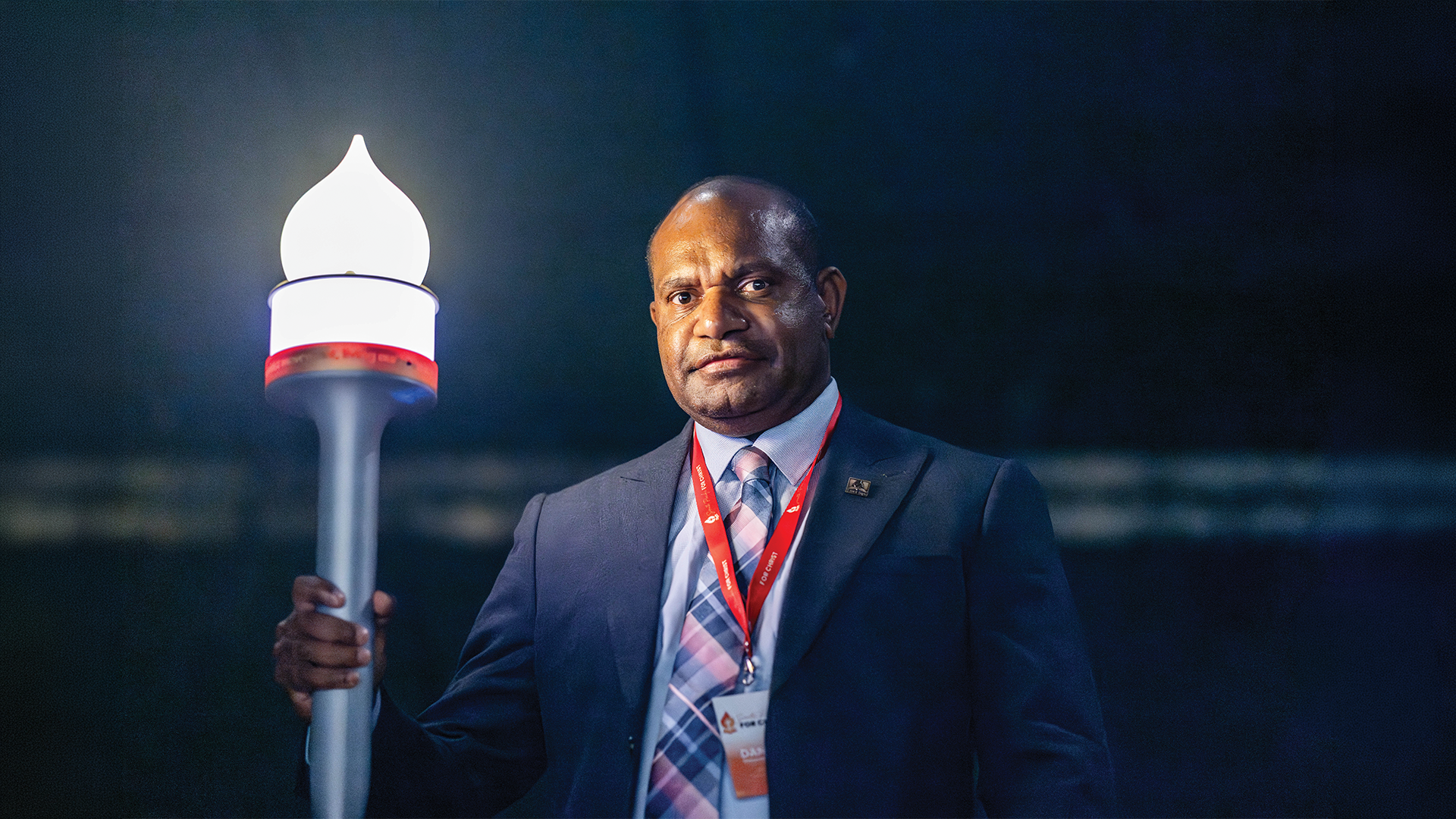
The South Pacific Division contains four unions. Adventist Record recorded interviews with all four union presidents during the South Pacific for Christ launch program in Brisbane, Queensland. In this issue, we bring you our chat with Pastor Danny Philip, president of the Seventh-day Adventist Church in Papua New Guinea.
Juliana Muniz (JM): How are you feeling about this event so far? What stood out to you this week?
Danny Philip: What stood out here at the SP for Christ launch is the mission—whether it be mission to different parts of the world, mission within our unions or to other places where we haven’t reached people. So for me, the focus here at SP for Christ is mission and how best we can engage everyone to be involved in reaching someone for Christ.
JM: So PNG for Christ will be the last of the “For Christ” events in the SPD, but it actually started in PNG in 2024. It was so successful then that it became an SPD-wide initiative. We know that the Church in PNG recently experienced growth, but what are the challenges that you are facing now over there?
Danny Philip: The growth comes with challenges as well. In PNG, one of the challenges we are facing is that when the Church was growing there was a lot of engagement but people now are more complacent, more relaxed and not as involved in church ministries. People might want to grow their own spirituality but not really want to engage in care group ministries or in other forms of community service. So ministry may not be as effective as it was during the COVID period in terms of trying to reach people. I think we need to wake them up again and say, “No, we still have a mission. We still have to go to the people. We still have to connect with people and engage everyone in the mission.”
JM: Can you share what your strategies are or your goals for this quinquennium?
Danny Philip: At PNGUM here during this quinquennium, we’ve got four key strategies. One is the mission. We want to focus on and have a strong emphasis on the mission part of it. Within the mission strategy we want to promote a daily communion with God. We want to ensure people have a strong spirituality in their life, in their homes and in their daily experience with Christ. We want to promote resources like Alive in Jesus, Back to the Altar, Bible reading plans and Sabbath school lessons. We want to revive a strong family focus in the home as well.
We also want to engage everyone to reach one—we have a strategy called “Each One Reach One”, so everyone does not become merely observers, but have a responsibility. Everyone can reach someone who they can share their story with. They can share their testimonies, they can have a prayer for someone, they can introduce Jesus to them. If everyone is doing what they can and using whatever gifts that God has gifted them to engage in mission, I think we can multiply church membership because everyone is doing something for the Lord.
The other strategy within mission is to make sure that every church is becoming a training school, a hub, where we train people to grow their faith and engage in mission.
We also have the strategy of service where we want to use ADRA as a key partner to reach out and connect with people. We want our schools to actually engage in ministry where they don’t just give head knowledge to the children, but also transform the heart with the Adventist message. We also want to work with health services; not just providing health services, but providing spiritual services using health ministry. We want to be more integrated in the way we do ministry to reach the people.
The other thing that we want to use is Adventist Community Services. ACS has been a great ministry that includes every age group: young people, children, mothers, fathers and families. Everyone joins ACS to meet the needs of the community and to bring people in the community back to Christ.
Then the other one we have is Adventist Aviation Services. They’re not just flying the plane, but serving the people in the rural communities. They fly out to the very mountainous places, rough and rugged, and they serve the people there.
We call the other strategy people and culture, where we want to train many people for service, whether it be in churches, in schools or leadership development for health leaders. We want to ensure that people are given skills and opportunities to be trained to serve in those places. The other thing we want to do within that strategy is to improve our governance systems. That’s one key area that PNG has not been doing well in—the governance systems in the churches, the missions, the Union or even in the schools and hospitals have not been doing really well, so we want to improve in that area.
There’s a lot of things that we want to do, but these are some key areas that we want to focus on in particular.
JM: Let’s talk about PNG for Christ. As we mentioned, it was a massive success in 2024 and you get to do it again in 2029. So, how are you preparing for that?
Danny Philip: The preparations for 2029 start now. That’s what I want to inform the church in PNG and everywhere. The preparation for 2029 PNG for Christ starts here in 2026. We had previously about eight years to deliver in 2024 and we only have about two years to start preparing for the 2029 PNG for Christ. I want to encourage the Church in PNG to start “Each One Reach One”. We want to encourage people to start growing small group movements to ensure that we connect with people. We are not just an isolated church that operates in the community. We want to see people serving people in the community. Make the presence of the Adventist Church felt in your community by connecting with your people.
JM: Before we close, in addition to PNG for Christ, what should church members in your region be aware of in terms of mission?
Danny Philip: To our people in Papua New Guinea, we don’t want you to be relaxed and comfortable thinking that we have delivered PNG for Christ in 2024 and are just observers of what happens in TPUM or NZPUC or in Australia. We want to encourage all churches and young people to start preparing for 2029 this year. We are already starting to send missionaries out as part of that. We’re going to send missionaries to Indonesia and to other places as well. But the most important thing is that the sending country must be very strong in mission so that we can actually support other parts of the world’s mission needs as well. We want to encourage everyone to do what we did in 2020. We want to encourage every church to participate.
This interview was recorded and published as a recent episode of Record Live: