A new study commissioned by the Seventh-day Adventist Church has revealed encouraging signs of spiritual openness across Australia and New Zealand, particularly among younger generations, while highlighting opportunities for the Church to strengthen its visibility and community engagement.
Conducted by McCrindle between February and March, the research surveyed Australians and New Zealanders in city and regional areas to better understand current perceptions of the Adventist Church and compare them with findings from a similar study conducted in 2022. The project was a joint initiative of the South Pacific Division’s communication department and ministry innovations and marketing department in partnership with the Australian Union Conference and New Zealand Pacific Union Conference.
The findings paint a nuanced picture. While public awareness of the Adventist Church has remained largely unchanged over the past four years, positive perceptions are growing in Australia, and younger generations are demonstrating a greater openness to faith and church involvement than many might expect.
One of the most notable findings was the broader shift in the religious landscape. The proportion of Australians identifying as Christian increased from 45% in 2022 to 51% in 2026, while New Zealand also recorded a slight increase from 36% to 39%. Weekly church attendance rose modestly in both countries, with younger age groups driving much of that growth. Among Australian Gen Z respondents, 44% reported attending church at least monthly, while the figure was 35% among New Zealand Gen Z participants.
Denominational awareness of the Adventist Church remained steady, with 56% of Australians and 51% of New Zealanders saying they were familiar with the Church. However, sentiment among those who knew of the Church improved in Australia, with positive perceptions increasing from 14% in 2022 to 17% in 2026. In New Zealand, positive sentiment remained relatively stable.
When respondents were asked what three words first came to mind when thinking about the Adventist Church, “Saturday” or “Saturday Sabbath” remained the strongest association in both countries. Other commonly mentioned terms included “religious”, “Christian”, “Jesus” and “church”. However, some respondents used less positive terms, including “weird”, “strange” and “cult”.
The research also revealed strengthening perceptions of the Church as a Bible-believing movement. In Australia, the proportion of people who identified the Adventist Church as “Bible believing” increased from 26% to 32% over the four-year period. New Zealand recorded a slight decrease, though the attribute remained one of the Church’s strongest identifiers.
Perhaps one of the most encouraging findings related to local church presence and community impact. Across both countries, about one in four people reported knowing of an Adventist church in their local suburb. Among those who were aware of a nearby Adventist congregation, perceptions of positive community impact increased significantly in Australia, rising from 31% in 2022 to 47% in 2026. New Zealand remained relatively stable.
At the same time, the study highlighted a visibility challenge. Most respondents reported having little or no exposure to Adventist advertising. Sixty-two per cent of Australians and 68% of New Zealanders said they had not seen any Church marketing or media.
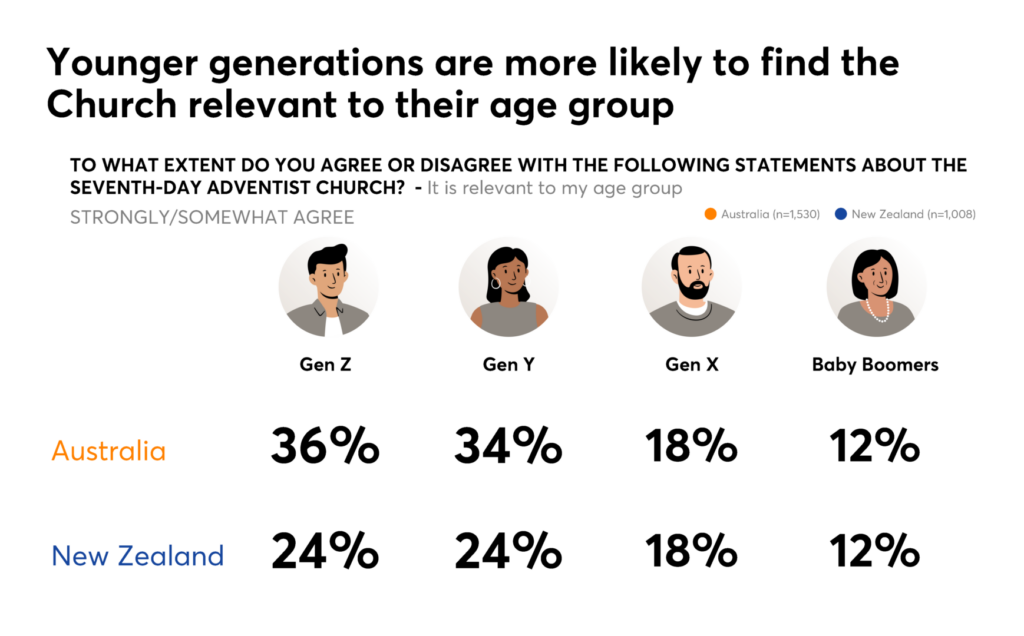
The research found the perceived relevance of the Adventist Church to people’s age groups increased significantly in Australia, rising from 15% in 2022 to 26% in 2026. Younger generations were far more likely than older cohorts to see the Church as relevant to them. More than one-third of Australian Gen Z and Gen Y respondents agreed the Church was relevant to their age group, compared with just 12% of Baby Boomers. Similar trends were evident in New Zealand.
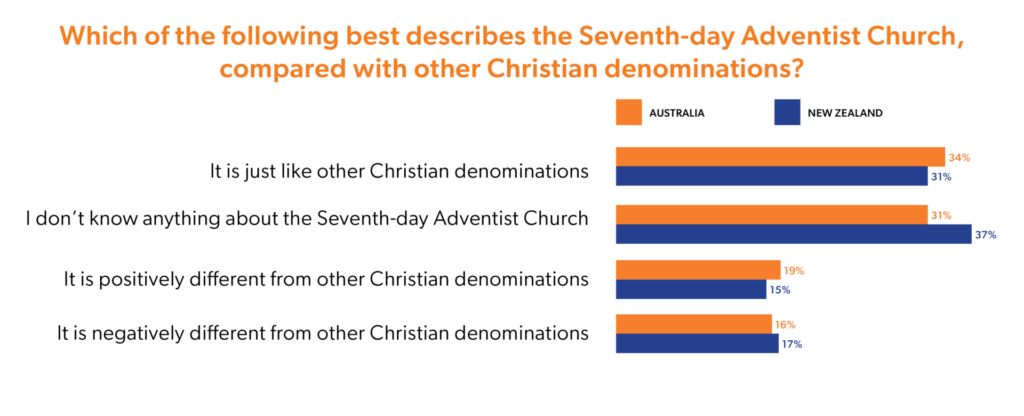
The research also suggests the Adventist Church is becoming increasingly distinct in the minds of those who know it. When respondents were asked how the Adventist Church compares with other Christian denominations, 19% of Australians said it was positively different, up from 13% in 2022. In New Zealand, the figure was 15%, up from 12% in the previous study.
Ministry innovations and marketing leader Tim McTernan said the findings indicate that many people remain open to spiritual conversations and church engagement, particularly younger generations.
“The research challenges the idea that young people are closed to faith,” Mr McTernan said. “In many ways, Gen Z may be one of the most important missional opportunities before us.”
Mr McTernan noted that younger people are not only more open to church engagement but also represent an opportunity for the Church to strengthen its mission and communication efforts.
“Gen Z are almost four times more likely in Australia, and almost three times more likely in New Zealand, to attend a Seventh-day Adventist church service than someone who is Gen X,” he said.
“The opportunity is more than just intentionally targeting the younger generation. McCrindle points out that we have the opportunity to ‘transition younger demographics from passive congregants to active cultural architects’. This means empowering our young people to lead and drive media, communications and practical ways to engage with our communities. This not only seeks to engage and retain our young people but also maximises the potential to engage their peers in the community.”
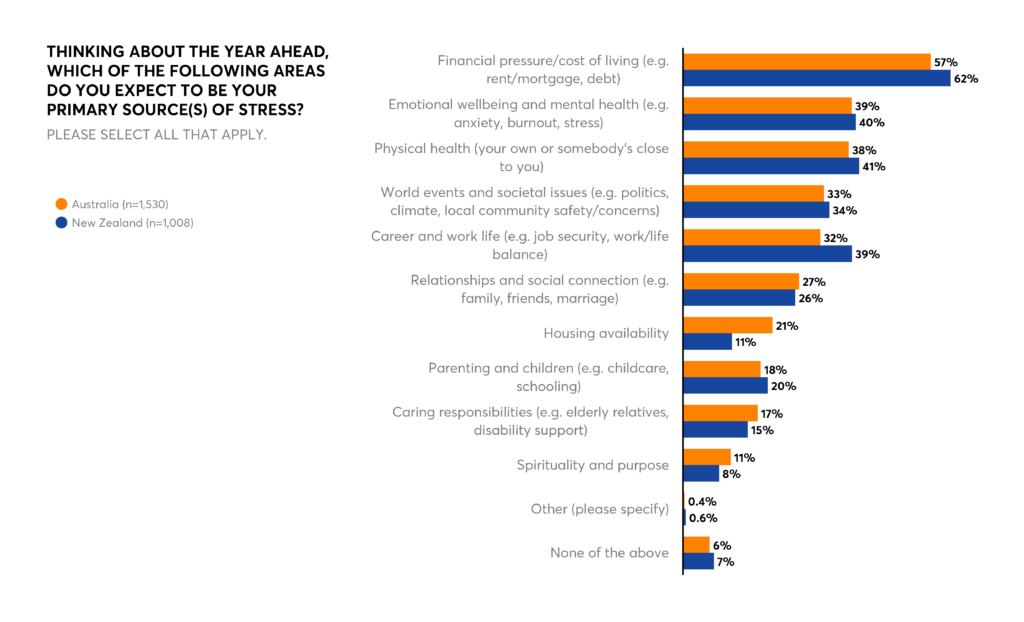
The study also explored the key pressures facing Australians and New Zealanders. Cost of living concerns topped the list in both countries, while other stressors included emotional wellbeing and mental health, physical health, world events and societal issues, and career or work-life pressures.
These concerns were reflected in another significant finding: community-focused programs were consistently more appealing than explicitly faith-based activities. Respondents indicated a growing willingness to attend church-facilitated community services, health and wellbeing programs, social events and community gatherings. While interest in faith-based programs was generally lower, younger generations were notably more open to participating.
Mr McTernan said there is an opportunity to connect the Church’s message with the real needs people are facing.
“Our beliefs are rich with public relevance. Sabbath speaks to an exhausted culture, our health message speaks to wellbeing, our community life speaks to loneliness, and the gospel speaks to hope, forgiveness and purpose. The challenge is to translate those beliefs into practical local expressions people can see, experience and trust.”
Mr McTernan said one of the disappointing findings is that the Church is not yet as visible as it needs to be in the digital space.
“If people are curious, they told us in the research that their first step is likely to be using a search engine or visiting a church website,” he said. “This means that the ‘digital front door’ really matters. Local church websites, social media pages and other digital channels are not just communication tools—they are now part of the mission pathway.”
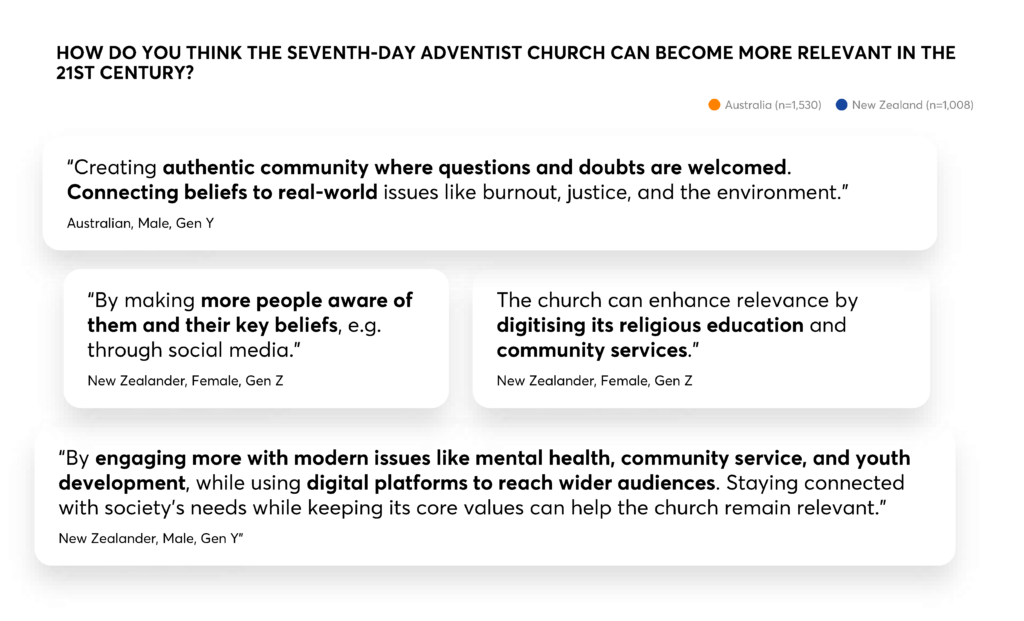
The study identified several strategic opportunities moving forward, including strengthening digital discoverability, increasing local community engagement and empowering younger members to lead media, communication and outreach initiatives. It also highlighted differences between Australia and New Zealand, suggesting localised approaches may be required in each country.
New Zealand Pacific Union Conference president Dr Eddie Tupa’i said the findings point to significant opportunities for the Church in New Zealand.
“New Zealanders are open to Christianity, value churches, are looking for community and practical help, and younger generations are surprisingly receptive,” Dr Tupa’i said.
“What they need is a church that is visible, welcoming, practical and easy to discover. The opportunity in New Zealand is not to convince people that faith matters; it is to demonstrate that the Adventist Church matters in their everyday lives.”
Watch Tim McTernan’s presentation on the McCrindle survey at the South Pacific for Christ launch below.
Tracey Bridcutt is the communication director for the South Pacific Division.