Book review
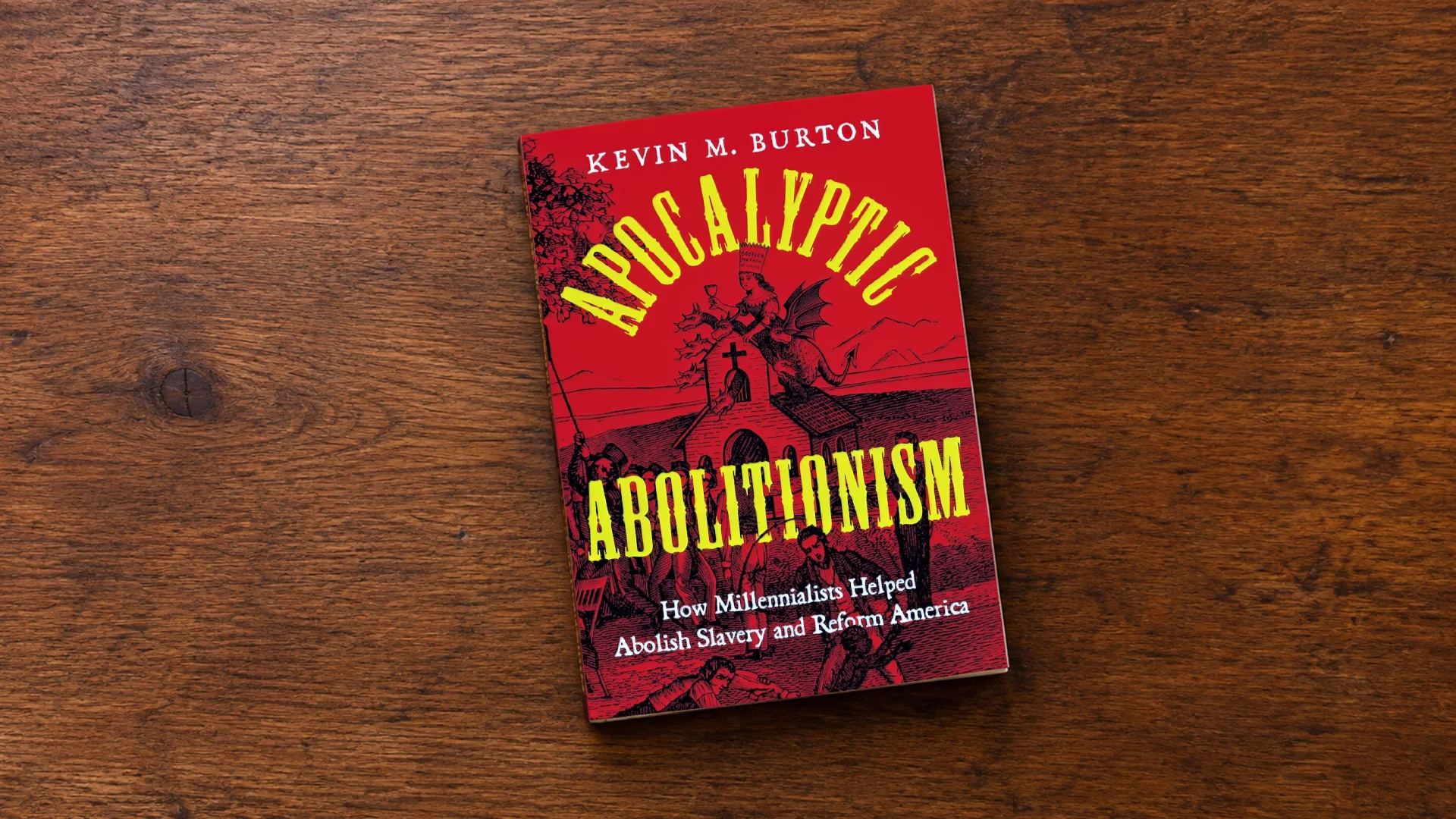
Apocalyptic Abolitionism: How Millennialists Helped Abolish Slavery and Reform America by Kevin M Burton.
New York University Press, 2026, 336 pages
These aren’t the Millerites I heard about growing up in church. The assumption has most often been that those most focused on and passionate about the (very) soon return of Jesus were less likely to pay attention to the world around them, much less to trying to set wrongs right, set people free, or change unjust laws and systems.
But a new generation of Adventist historians are asking different questions and rebutting some of these presuppositions about our Adventist forebears—of which Apocalyptic Adventism is perhaps the best example yet.
Author Kevin Burton is director of the Center for Adventist Research and Assistant Professor of Church History in the Seventh-day Adventist Theological Seminary at Andrews University. His new book has grown out of his doctoral research, which not only asked different questions but also adopted different research methods to arrive at some surprising answers and insights.
In short, Apocalyptic Abolitionism argues that during the time of the Millerite preaching and expectancy (1831–1844) these fervent believers were among the most engaged and active in the work of abolitionism, seeking liberty for enslaved people in the United States and an end to the institution of slavery itself. Dr Burton details how William Miller and other leaders were themselves converted to this preeminent justice cause of their time and that, by 1840, about 90 per cent of Millerites were also abolitionists (page 41). Belying the assumption of their expectant passivity, “Adventist apocalypticism provided biblical evidence that injustice was both a personal and structural problem and prophesied permanent reformation through God’s fast-approaching liberation. Simply put: Millerism created a contagious hope that permeated the atmosphere and animated radical reform movements” (page 199).
Dr Burton argues that their strident abolitionism was a key reason the Millerite movement did not reach beyond the north-eastern United States, because Southerners “perceived Adventism to be a threat to their peculiar institution [slavery] and feared anything that might spark slave uprisings” (page 132). Thus, the geographical limitations of Millerism are both historical evidence of their commitment to this cause and surprising, given the apparent urgency of their message. It seems they were prepared to sacrifice the spread of their message for the priorities of justice and freedom for the most oppressed people.
But this survey of Millerism also highlights the tensions with the surrounding religious landscape. This was what gave birth to the “come-outerism” of many of the Millerites: “the evangelical majority was the most oppressive force in America” (page 122). This is a significant insight offered by Dr Burton’s research for contemporary contexts. Most religious historians—see, for example, Bad Faith by Randall Balmer—trace the subversion of American evangelism from the rise of the religious right in the late 1970s as a reaction against the gains of the Civil Rights Movement to their overwhelming support of Donald Trump. But Apocalyptic Abolitionism sees these current trends more as “a recent manifestation of an evangelical conservatism rooted in slavery and Jim Crow”—as such, less historical anomaly than exactly what the Millerites were also rejecting and critiquing in their time.
Remarkably, as the time of Jesus’ anticipated return grew closer, a number of Adventists ran for political office as candidates for the Liberty Party in 1843 and 1844, with Adventists preparing themselves for Jesus’ return “by praying and voting with apocalyptic enthusiasm” (page 187). While the Millerites met their Great Disappointment and this slowed the ongoing abolitionist project, there is a political through-line that leads to President Lincoln and the official end of slavery in the 1860s: “Though their timing was off and their vision opposed, the Millerites’ millennial dreams challenged America to embrace a better democracy” (page 204). And, of course, this is also the immediate heritage of those who would become the founders of the Seventh-day Adventist Church.
At times, it is tempting to suggest that the meticulous research behind Apocalyptic Abolitionism gets in the way of the story it is telling. Some of the lists of names act as extended punctuation in this history. But so startling, so different from the Millerite stories that I heard growing up, are some of Dr Burton’s arguments, that it is good to be reminded of the work that has got him there and that we benefit from as his readers. He describes the Millerites as “incessant radicals” with an Adventism that “inspired and activated the cause of justice” (page 199). By asking different questions of our Adventist history, we can find different answers and re-discover a heritage that could make us a different kind of church: a faithful people with contagious hope and liberative urgency.