When Jonathon Ginn first picked up the violin, he couldn’t have imagined he would one day be playing it in front of a petrol station. He was around six years old when his parents took him to hear Adventist violinist Jaime Jorge perform. Soon, Jonathon told his parents he wanted to learn the violin.
“There were definitely times growing up when I wanted to quit,” he admits. But he kept going—partly because he enjoyed it and partly because his parents encouraged him. Later, his mother suggested he try busking. “When I realised I could earn decent money playing violin at a supermarket or a shopping centre, I thought, Maybe I’ll stick with this.”
At first, music was not the plan. Jonathon wanted to study medicine but, after several attempts to get into medical school, he eventually became an osteopath. He also ran a tutoring business and busked where he could. Then COVID-19 made busking difficult, so Jonathon began looking for other income streams. Playing at events became the natural next step.
“I stumbled into playing for weddings,” he says. “It wasn’t something I had always planned to do.” He soon learned the realities of running a small business. Music, especially wedding music, is often seasonal. On the Gold Coast (Queensland), the busiest months are April through November, with summer often being much quieter.
For a long time, he resisted advertising on social media. “I actually really don’t like it,” he admits. “I think probably 90 per cent of social media has fairly negative consequences or effects on society.” He had Facebook but barely used it. He didn’t even have Instagram until his wife set up an account for his business. Still, Jonathon mostly relied on Google, his website and booking platforms. That all changed after a videographer he knew saw him busking on the Gold Coast and gave him some simple advice: people needed to hear what he sounded like. So, begrudgingly, Jonathon bought a microphone and started posting on social media.
At first, the content was straightforward. But as he learned more about Instagram, he realised that beautiful music alone was not always enough to stop the scroll.
“If only half the people are listening with sound on, then you’re losing half your audience before they’ve even started watching.” So, Jonathon began experimenting. He tried strange ideas. He learned to tell more of his own story. Then war broke out in the Middle East.
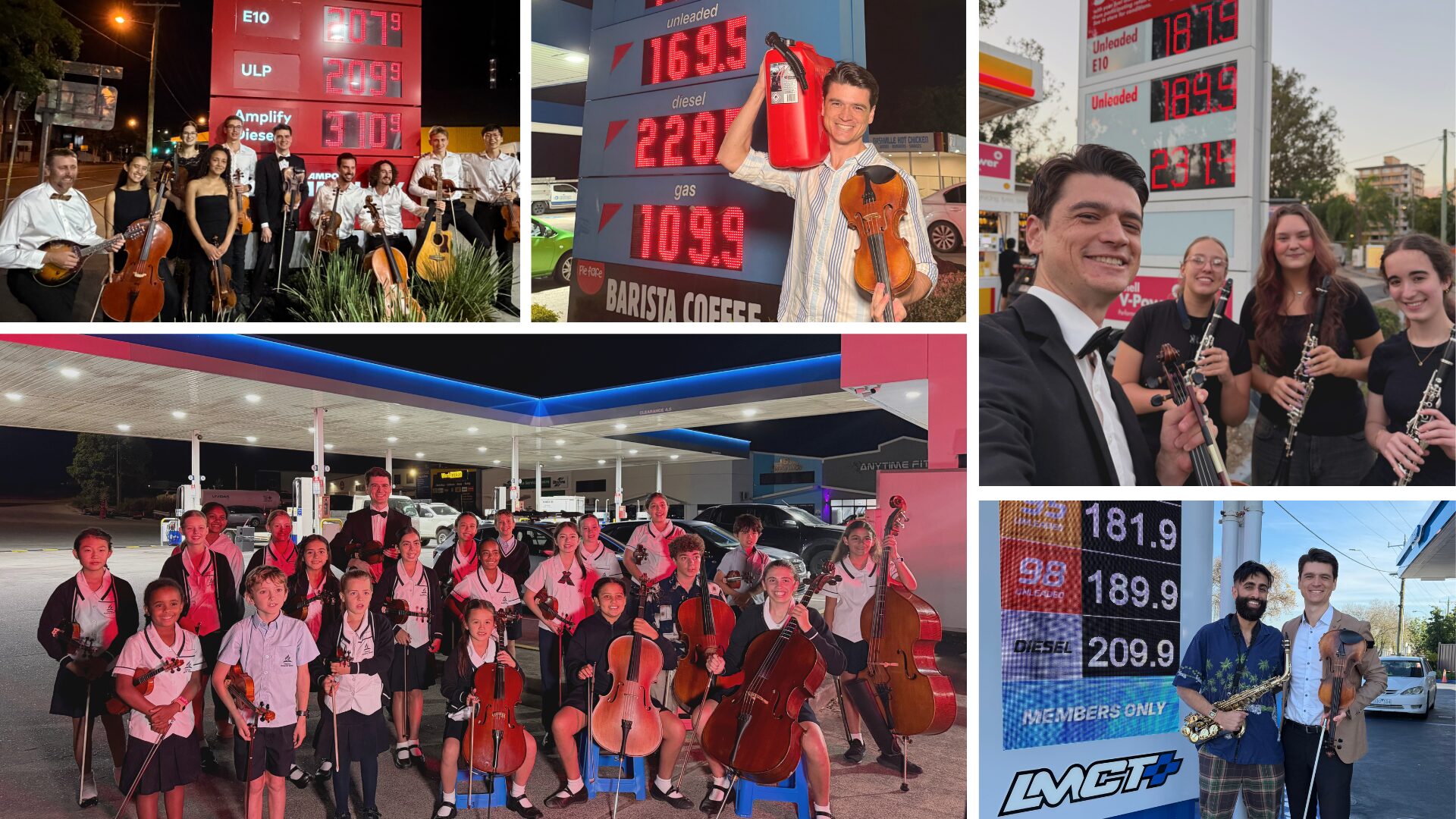
One Sunday in early 2026, Jonathon had an idea. Fuel prices were rising. Filling up the car was beginning to feel like a luxury experience. What if he treated it like one? A few days later, he and his wife went to a petrol station. She filmed the price board, then panned across to Jonathon standing there with his violin. The caption was simple: “Adding live music to an upper-class experience”.
At first, the video performed well enough. Jonathon had around 3000 followers on Instagram at the time, so when the video reached a few thousand views, he considered it a decent result.
Then, the next morning, his phone started blowing up. By 11am, the video had around 200,000 views. Soon it was being shared widely. In the end, it racked up more than 17 million views on Instagram.
What partly made it work was the joke. Everyone understood the pain of rising fuel prices. But the comments became part of the entertainment too. Some compared the moment to the band playing as the Titanic sank. Others requested “Nearer My God to Thee” and “My Heart Will Go On”. Americans, confused by Australian fuel prices listed per litre, wondered where they could find fuel so cheap. Then everyone else had a great time mocking them. “It was kind of carnage,” laughed Jonathon. “There are always people that take it to the extreme but for the most part, it was people genuinely having a laugh.”
Jonathon decided to keep going. He started filming at different service stations, joking that he would play until he received a free tank of fuel. He also began inviting other musicians.
First were a violin and cello. Then two violins and a cello. Then a quartet, a quintet and then an 11-piece ensemble. At one point, a man walking past with a piano accordion joined in. Later, a group of around 22 students from Toronto Adventist School joined him. One follower has commented nearly every day asking for a full orchestra at a petrol station. Jonathon admits that is now something of a dream—even though it would be a difficult proposition. A full orchestra would mean finding enough musicians, transporting instruments, choosing the right petrol station and making sure no-one obstructed traffic. “I do really want to pull that off,” he says.
Not every petrol station welcomed Jonathon. A few asked him to leave, mostly out of concern about liability or disruption. Others embraced it. The videos also became more than a joke when Jonathon began using the attention to give away free tanks of fuel to strangers. Once, a man heard about the fuel giveaways, handed Jonathon $A300 and simply walked away.
“It’s been cool to see,” Jonathon says. “Because I had a vision for what I wanted to do, lots of people have been keen to facilitate it and cheer other people up along the way.” So far, Jonathon has given away around 13 tanks of fuel, worth about $A1600. His goal is to give away 20, including a larger giveaway for a small business that uses a truck. For Jonathon, the generosity has become one of the most meaningful parts of the whole experience.
“I don’t see it necessarily as witnessing,” he says. “But when people see someone doing kind things or loving things, it’s a good way for people in the community to be cheered up.” The viral attention has also helped his business. Jonathon has seen more enquiries through Instagram and more people recognising the petrol station videos when he arrives at weddings. “Today, at least 30 per cent of my bookings come directly from people finding me on Instagram,” he says. But there is one aspect of the business he continues to have a strict boundary around.
As a Seventh-day Adventist, Jonathon observes the Sabbath. In the wedding industry, that is problematic.
“About 60 per cent of weddings happen on a Saturday,” he says. When Saturday requests come in, Jonathon sends a polite reply congratulating the couple and explaining that he takes a day of rest from Friday sunset to Saturday sunset, so he is unavailable. “Most of the time people are usually quite respectful of it. Other times I might not get any response.
“There might be weeks where I get four, five or six Saturday wedding requests that I’ve got to say no to,” Jonathon says. “Other weeks, I book a few gigs, and I think, Praise God, this is awesome. I do think that God’s blessed me with plenty of work from Sunday through to Friday. It challenged my faith because it has forced me to rely more on God.”
Sabbath has been part of Jonathon’s faith since childhood, though not always without tension. He loved sport, especially cricket and golf, which were often played on Saturdays. As he grew older, he studied the Bible for himself to understand why Sabbath mattered.
“I like to make myself busy,” he says. “I find the Sabbath is a great way to stop what I’m doing throughout the week and reorient myself towards God.”
For Jonathon, Sabbath means no violin admin, no business tasks, no practising for work and, where possible, no social media. It is time for God, family, church, community and rest. Jonathon sees the irony. The same platforms that helped him become known for playing violin at petrol stations are also platforms he needs to step away from.
“I find it really good just to reset my mind,” he says.
Jonathon is still figuring things out as he goes along. For now, he is enjoying the chance to make people laugh, brighten someone’s day and trust that the work he receives is enough.
“Ultimately, every gig I get is a blessing from God,” he says.