Trans Pacific (TPU) for Christ has come to an end—a massive evangelistic campaign involving more than 1800 individual sites over two months spanning the breadth of the South Pacific. Naoero, Vanuatu, Solomon Islands, Tuvalu, Fiji, Tonga, Niue, Samoa, American Samoa and Kiribati all opened their doors to thousands of speakers, health professionals and volunteers from across the South Pacific Division, the United States, South-East Asia, Europe and beyond, all with a single purpose—to declare the soon coming of Jesus and invite people to follow Him. When faced with the scale of the efforts, it’s easy to get lost in the numbers—especially when what is most often reported are numbers—numbers of sites, numbers of attendees, number of baptisms—you get the point. It’s often easy to miss the individual stories of the church communities who partnered with international speakers—and who continue to faithfully serve their community long after those speakers return home. I’d like to tell one of those stories.
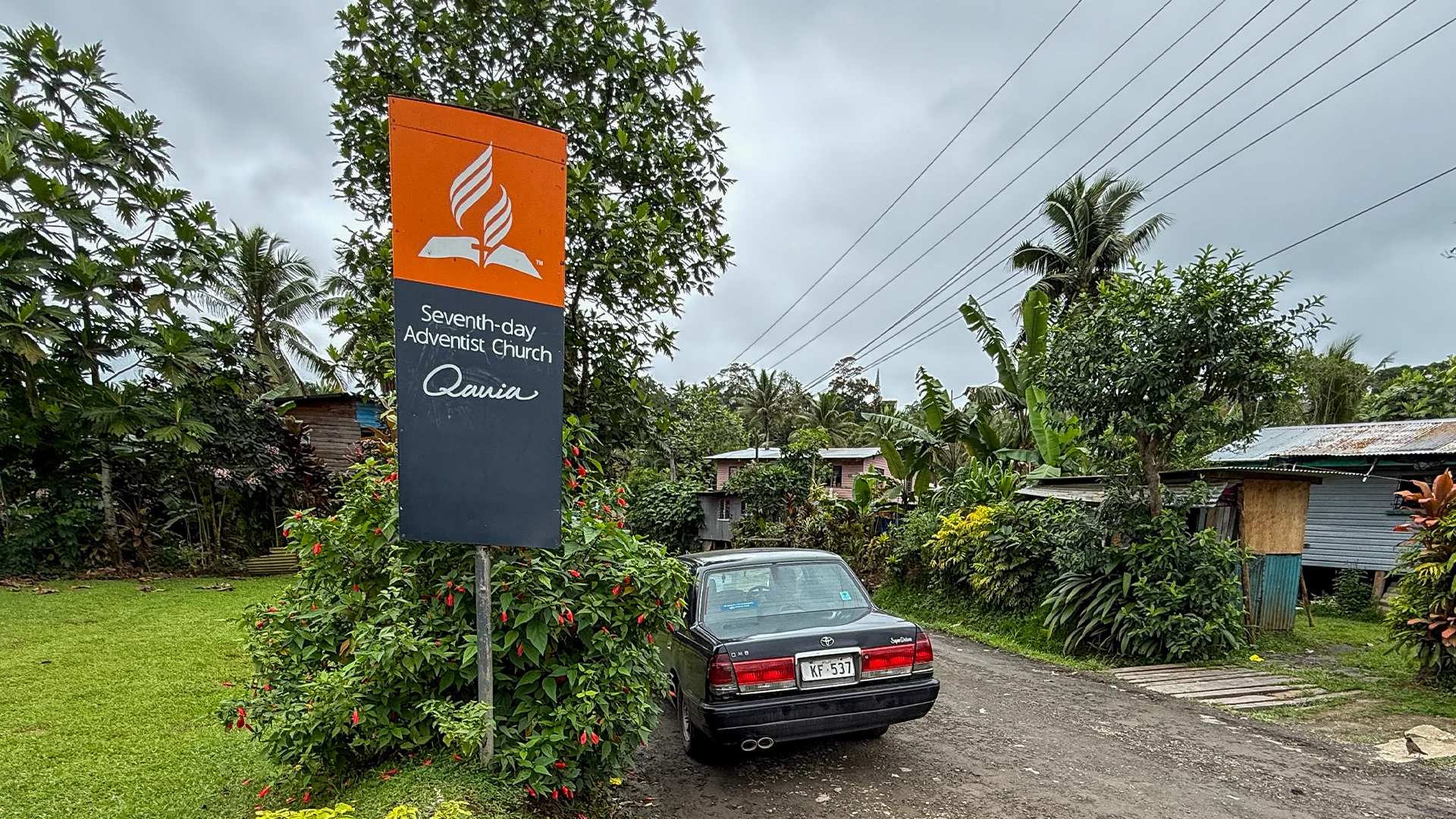
I preached in a village in Fiji called Qauia (Gah-wee-uh). It’s a small place just west of Suva that begins at a bridge over the Lami River and ends at the foothills of Mount Korobaba (the tallest mountain in the Suva area). Qauia itself is made up of about 400 homes and is home to several congregations, including Assemblies of God (AOG), Brethren, Methodist and Adventist churches.
When I first arrived in Qauia, I was immediately struck by the ingenuity of its inhabitants. The local Adventist church is bordered by a small pocket of farming land—inlets where water gathers and in turn irrigates the dalo (taro) that grows on the irregularly—but intentionally—raised embankments. Behind the church is an outhouse and shower—as well as housing that stretches up the hills that enclose the valley. No space is wasted. Each home is surrounded by greenery—gardens, farm plots and flower beds. Houses are built from a variety of materials—wood, concrete, corrugated iron or a mix of the three. Taxis constantly move up and down Qauia’s singular potholed street, navigating around dogs, children and parked cars. Children use the street as both a gathering point and playground. Games such as volleyball and football are common, as well as a curious one where children roll tyres at each other in what I can only describe as a mix between bowls and frisbee golf.
Qauia Adventist church is an established congregation, several decades old and made up of a wonderful patchwork of characters. The church’s foundational backbone are its elders—some long-standing Adventists, others more recent converts. One particular gentleman, known as “Bola”, told me he used to be quite the ruffian. “I would go down to the police station and get into fist fights with them,” he once remarked in a surprisingly casual way. Bola grew up an Adventist, but left the church in his twenties, becoming a “backslider”. “Thank God for a faithful wife,” he said. His wife, who had been a faithful Adventist, had prayed for Bola for years. Finally, he gave up his life of vice and violence and joined the church. Today, he is the oldest member of the church and plans to live to at least 100.


Simione, affectionally known as “Skipper”, and his wife Divika are on the other end of the spectrum. Newly baptised only a year or so ago, they and their family are now mainstays in the church. Skipper runs the church’s A/V while Vika helps with catering and the children’s ministry. The family also played a vital role in the Fiji for Christ evangelism program. Skipper and fellow church member Epeli—a taxi driver with the presence of Forest Whitaker’s Idi Amin in The Last King of Scotland—shared A/V duty, but Skipper and his family bore most of the burden of security. Given we were an open-air site, theft and vandalism concerns were real, meaning someone needed to be present 24/7. Skipper, his family and one other church member provided said security, in addition to their other responsibilities. Though they are new members, they are just as dedicated as the longstanding Adventists in the church.
Mijieli, or “Miji”, is the church’s head elder. He and his wife Elena are widely travelled, and lived in Australia for many years ministering to Aboriginal teens in the Northern Territory (a story for another day). He was my main intermediary to the community, especially for locals who weren’t confident English speakers. We spent a significant amount of time going door-to-door, sitting on living room floors, speaking to members of the community, offering prayer and inviting them to the evangelism program. An unassuming man, over the time spent in Qauia, I soon saw his great heart for ministry, as well as how well-connected he is. After leaving a house, he would often turn to me and remark, “She’s my second cousin” or “that young man is my nephew”, or something like that. Regardless of whether they were Methodist, AOG or Catholic, it was obvious how much respect the community has for him.
My site coordinator was Finau. She’s a mum to Junior and Paulina, and wife to Ben. She’s a creative, entrepreneur and leader. She and her family not only welcomed me to Fiji—but thanks to some unfortunate accommodation challenges they ended up hosting me for much of my time there. I especially appreciated her tireless service. During the first week, a team of medical missionaries visited Suva, and Finau assisted them as part of the ground team. Despite the long days, she remained tirelessly dedicated to the numerous responsibilities required to keep our site going.
As many of us well know, a church is not a building. A church is a network of people who, on the surface, may seem different, but are nevertheless united by a common cause—the cause of King Jesus. Though flawed and frail, the church embodies the mission of Jesus in ways evangelists simply cannot. At the end of the second week of Fiji for Christ, I felt convicted to encourage the team for the future. While I returned home, they continue to faithfully disciple new Christians, serve their community and live out their calling as the incarnational body of Christ. Just the other day, Miji contacted me to let me know that those who had been baptised were going through Bible studies together, and that Qauia church is inviting their family members to a picnic to encourage them. That’s what the church is. That’s what the church does.
Jesse Herford is the editor of Adventist Record.