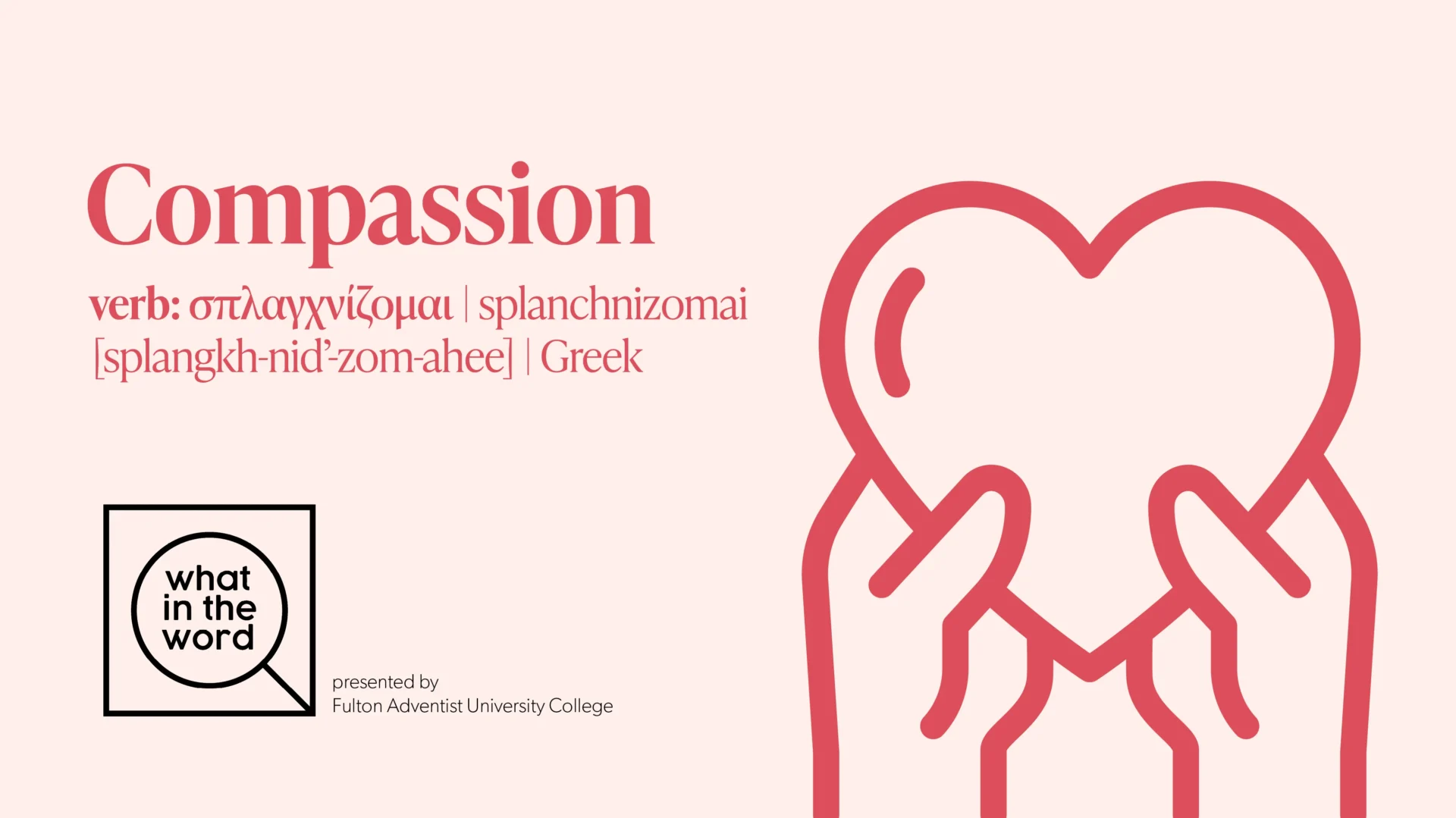
Splanchnizomai (σπλαγχνίζομαι) is one of the New Testament’s most vivid words for compassion. In Luke 10:33, Jesus says that a Samaritan saw a wounded traveller and “had compassion”. Derived from a Greek word for the inner organs—regarded as the seat of deep emotion—it describes compassion felt so profoundly that it moves a person to act.
Jesus used this word in answer to a lawyer who asked, “And who is my neighbour?” (Luke 10:29*). His parable begins with a traveller attacked by robbers, stripped, beaten and abandoned beside the road. A priest saw him and passed by. A Levite also saw him and passed by. Both recognised suffering, but neither crossed the distance between observation and assistance.
Then came the least expected helper—a Samaritan.
Deep religious and ethnic hostility separated Jews and Samaritans. Yet when the Samaritan saw the injured man, he was moved with splanchnizomai. His compassion crossed both the road and a cultural boundary. He treated the wounds, placed the man on his own animal, carried him to an inn and paid for his continuing care (verses 34, 35). Biblical compassion gives time, accepts inconvenience, expends resources and draws near to suffering.
Luke uses splanchnizomai in two other memorable scenes. When Jesus saw the widow of Nain walking behind the bier of her only son, “He had compassion on her” and restored the young man to life (Luke 7:13–15). In Jesus’ parable of the lost son, the waiting father saw his returning child from a distance, “had compassion, and ran and fell on his neck and kissed him” (Luke 15:20).
Together, these scenes reveal divine compassion. Jesus approaches the grieving widow. The father runs towards his returning son. The Samaritan crosses the road towards the wounded traveller. Splanchnizomai moves in the direction of need.
This is also the movement of the gospel. God did not observe humanity’s suffering from a safe distance. In Jesus Christ, He entered our wounded world, bore our sins and opened the way home. “But God demonstrates His own love toward us, in that while we were still sinners, Christ died for us” (Romans 5:8). At the cross, divine compassion did not merely feel our pain; it acted to save us.
I experienced a small but unforgettable picture of such compassion in July 2025. My wife and I, members of Fulton’s Theology faculty, were attending the General Conference Session in St Louis, Missouri. After the opening and Sabbath program, however, I had to rush my seriously ill wife back to New Zealand on Sunday. We did not yet understand the cause of her illness.
In my distress, I mistakenly booked our return journey from San Antonio, Texas, where the previous General Conference Session had been held, instead of St Louis. When we realised we could not reach San Antonio in time, we rebooked a direct flight from St Louis to Houston to connect with our flight to Auckland.
We landed in Houston as the final boarding call was being announced. The international terminal seemed kilometres from the domestic terminal. My wife was ill, we were unfamiliar with the airport and time was disappearing. Then a kind elderly man noticed our distress and showed us how to reach the international terminal. With his help, we reached the departure gate in time.
We never learned much about him, but we remember what he did. He could have hurried past. Instead, he saw our need, drew near and offered practical help. At that critical moment, his kindness carried us across a distance we could not manage alone.
The Good Samaritan likewise shows that compassion cannot be confined to people who resemble us, agree with us or belong to our community. Jesus reframed the lawyer’s question. Rather than defining who qualified as a neighbour, He asked which traveller “proved to be a neighbour” to the wounded man (Luke 10:36). The decisive question is not only, “Who is my neighbour?” but, “To whom will I become a neighbour?”
We encounter wounded people beside many roads: a grieving colleague, a struggling student, a displaced family, a lonely church member or a stranger overwhelmed in an unfamiliar place. We cannot solve every problem, but compassion asks what help we can offer now.
Remember splanchnizomai. Christian compassion sees, draws near and acts. Having received such mercy from Christ, may we cross the road and become the neighbour someone needs.
Dr Limoni Manu O’Uiha is the dean of the school of Theology at Fulton Adventist University in Fiji.
*All verse references come from the NKJV.