Battle Creek, Michigan, may seem a world away from the South Pacific. Yet, for Seventh-day Adventists, this American village is also part of our story. What began in Battle Creek in the mid-19th century helped shape the development of Adventism in Australia, New Zealand and the Pacific Islands.
In May 1863, a handful of Adventist pioneers gathered in Battle Creek and formally organised the Seventh-day Adventist Church. It wasn’t in a grand cathedral, but in a simple meeting space. Out of that small beginning came a structure that gave direction, unity and focus to the mission. The pioneers believed that organisation wasn’t an end in itself but a way of advancing the gospel with order and unity.
From there, Battle Creek quickly became the heartbeat of Adventist life. The Review and Herald Publishing House, Battle Creek College (the first Adventist higher education institution, chartered in 1874) and the Western Health Reform Institute (later the world-famous Battle Creek Sanitarium) were all established there. God’s Spirit guided the pioneers in building institutions that combined preaching, education and health—a vision of holistic mission that mirrored the ministry of Jesus, who cared for body, mind and spirit (Matthew 4:23,24; Luke 2:52; 7:22,23; John 10:10).
Battle Creek was also a place where the church learned how to be global. By the late 1800s, the church recognised that its message could not remain in North America alone. By 1901, the leaders reorganised the church into a global movement to support worldwide mission, and just two years later, the headquarters moved to Washington, DC, indicating that the church was no longer a North American body—it was becoming a global family. Ellen White wrote just after the move, “The removal to Washington of work hitherto carried on in Battle Creek is a step in the right direction. We are to continue to press into the regions beyond, where the people are in spiritual darkness.”1 This transition underlines the theological mandate of a global vision: the everlasting gospel is for every nation, tribe, tongue and people (Revelation 14:6), making Adventism’s identity an inherently worldwide movement.
How did this affect the South Pacific? In May 1885, the first organised mission party led by Elder Stephen Nelson Haskell and a team of 11 aboard the Royal Mail Steamship left San Francisco and arrived in Sydney the following month to begin the organised work there. “The expedition to Australia was part of a new phase in the evolution of Adventism; it was moving out from being a small American sect to being a worldwide and rapidly growing movement, stretching out to almost every corner of the globe.”2 Their mission methods reflected what they had seen in Battle Creek: public evangelism, strong literature work and the establishment of institutions. Within months, they were printing Bible Echo, which later became Sign of the Times. In this way, the DNA of Battle Creek’s publishing work was transplanted into Australia. Five years later, in 1890, the two-masted schooner Pitcairn sailed from San Francisco on its first missionary voyage. Its crew visited Pitcairn Island, Tahiti, Tonga, Samoa, the Cook Islands, Norfolk Island and Fiji, distributing literature, holding meetings and providing medical care. Each voyage of the Pitcairn was a living extension of Battle Creek’s legacy: printing, training, providing medical care and sending people determined to take the gospel to the regions beyond.
Ellen White, during her years in Australia (1891–1900), saw the same sacrificial spirit she had witnessed in Battle Creek. Speaking of the work in Cooranbong, she wrote: “the same process [of sacrificing] must be gone through again [in Australia] as when. . . we started the work in Battle Creek.”3 In Cooranbong, she helped inspire the establishment of Avondale College (now Avondale University) and the Sydney Sanitarium (now Sydney Adventist Hospital), both modelled on the integrated mission approach developed earlier in Michigan. White’s guidance ensured that the South Pacific work carried the distinctive blend of health, education and publishing that had been nurtured in Battle Creek.
Today, the South Pacific Division is home to vibrant churches, schools, hospitals and publishing work. Every one of them, in some way, is fruit from seeds planted in Battle Creek. The Adventist pioneers in Michigan could never have imagined how their vision and sacrifice would one day reach our shores.
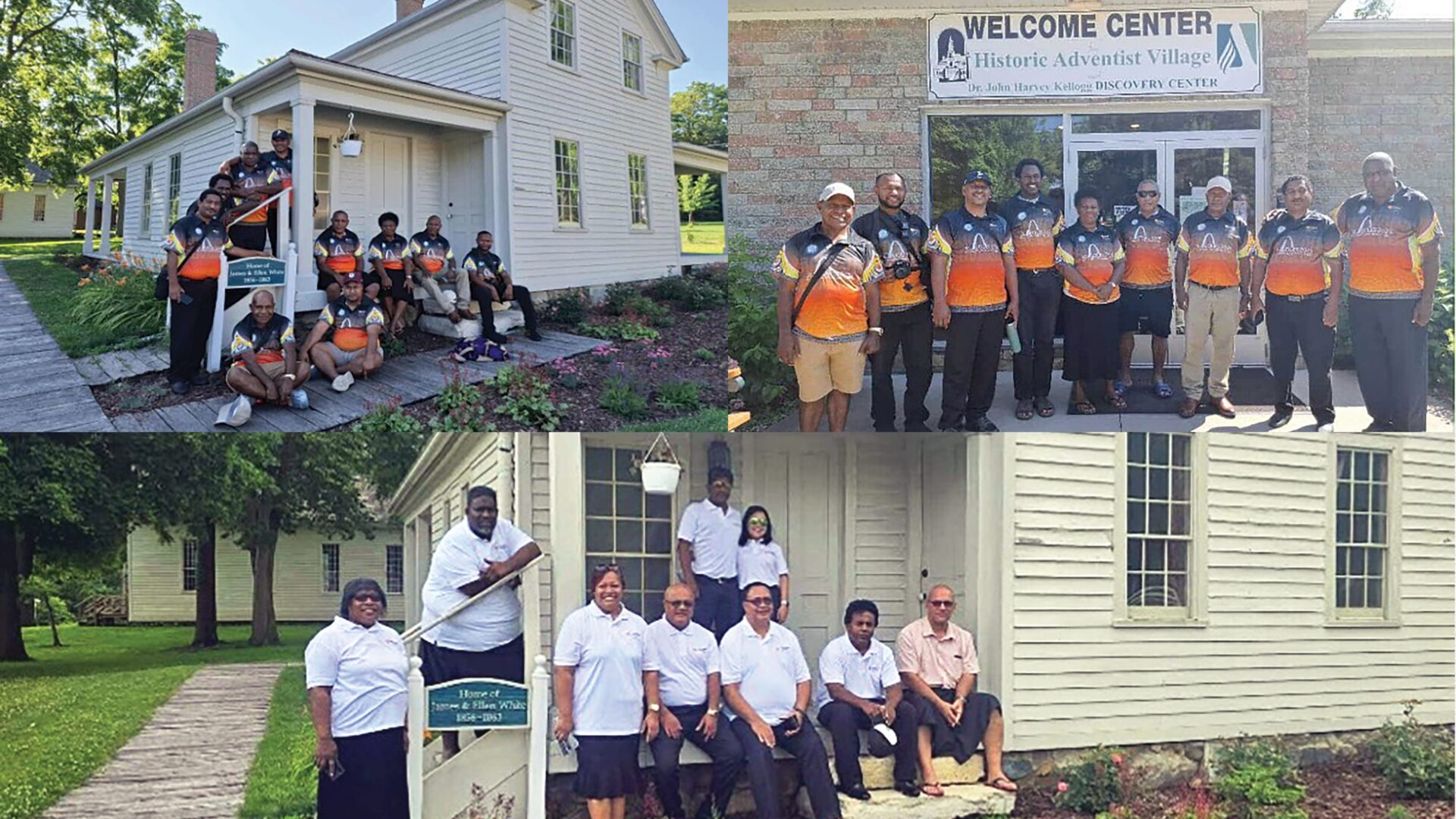
And yet Battle Creek’s story continues to live on. The Adventist Village, preserved today as a heritage site, invites visitors to step back in time and witness the origins of the Seventh-day Adventist movement. The village features restored historical buildings such as the 1857 Parkville Church, the Second Meetings House, the home of James and Ellen White, and the restored homes of early leaders like Uriah Smith and John Harvey Kellogg. Visitors can explore exhibits of early printing presses, period furniture and artifacts that illustrate the growth of Adventism’s health, education and publishing ministries. The Battle Creek Sanitarium building, though no longer Church–owned, still stands as a testament to the Church’s innovative health vision. Each year, heritage tours and reenactments attract visitors from around the world who come to walk in the footsteps of the pioneers and rediscover the movement’s beginnings.
In July, the story of Battle Creek’s enduring influence gained fresh expression. As delegates from around the world journeyed to St Louis, Missouri, for the 62nd General Conference Session, many paused along the way to visit this historical site of Adventist mission. Among them were faculty members from Fulton Adventist University and Pacific Adventist University, as well as pastors and ministers from the Central Papua Conference. Their presence in Battle Creek symbolised more than a historical tour—it was a living connection between the cradle of the Adventist movement and the vibrant mission fields of the South Pacific. Standing where the early pioneers once prayed, printed and planned for global evangelism, these leaders represented the fruit of the same missionary vision now flourishing across the islands of the Pacific.
Battle Creek is not just an American Adventist story—it is our story too. It reminds us that God often begins His greatest works in small and seemingly insignificant places. From a humble meeting room to a global fellowship, the journey of Adventism is a living witness that faithfulness in one corner of the world can ripple out to transform lives across oceans. Visiting this heritage site, therefore, offers believers in the South Pacific a special opportunity to connect with our spiritual roots, draw inspiration from the pioneers’ unwavering faith and renew our commitment to the worldwide mission that began here. For Adventists throughout the South Pacific, Battle Creek calls us to cherish our past while living with renewed purpose—many cultures, one people, united in one mission.
- Ellen White, Letters and Manuscripts, vol.18 (1903), par. 04. See <m.egwwritings.org/en/book/14068.8568001> (accessed Oct 10, 2025).
- Noel Clapham, “Origins,” in Seventh-day Adventists in the South Pacific, 1885-1985 Australia, New Zealand, South Sea Islands, (Warburton: Signs Publishing, 1985): 13.
- White, Letters and Manuscripts, vol. 14 (1899): pars. 25–26. See <m.egwwritings.org/en/book/14064.5785001> (accessed Oct 10, 2025).
Peter Ohura Korave is a PhD student in Religious Studies at Andrews University.