Famous atheist Richard Dawkins once claimed that the God of the Old Testament (OT) is “a vindictive, bloodthirsty ethnic cleanser; a misogynistic, homophobic, racist, infanticidal, genocidal . . .” People who reject God for whatever reason feel justified in their position by such characterisations of God. The reality is that the God of the OT is the complete opposite of what Dawkins thinks He is. In fact, He is no different to the God of the New Testament (NT).1 Jesus is the exact expression of God. He said, “If you have seen Me, you have seen the Father” (John 14:9). According to the NT, Jesus was the God who brought the Israelites out of Egypt and led them into Canaan (Jude 5;1 Corinthians 10:4,9). So, how do we deal with the conquests of Canaan, which God ordered the Israelites to undertake?
To begin, we need to understand literary context. When we come across media, we naturally adjust our interpretation of it according to its genre and the figures of speech used. For example, if someone reported that every man and his dog were at Big Camp, we would understand that to mean that there were a lot of people there, including both men and women, but probably no dogs, and certainly not every man. We would understand a sports report that stated Team A annihilated Team B to mean that Team A had a decisive victory over Team B, without any fatalities.
The same applies to the Bible. We need to adjust to the various genres and figures of speech. Even the most fundamentalist Christian does not interpret everything literally. For example, when Jesus called King Herod a fox (Luke 13:31,32), everyone understands that this is not to be taken literally. If Jesus Himself used figures of speech, should we expect anything different from the inspired authors of the Bible? It quickly becomes evident that the Bible is the word of God in human words and concepts.
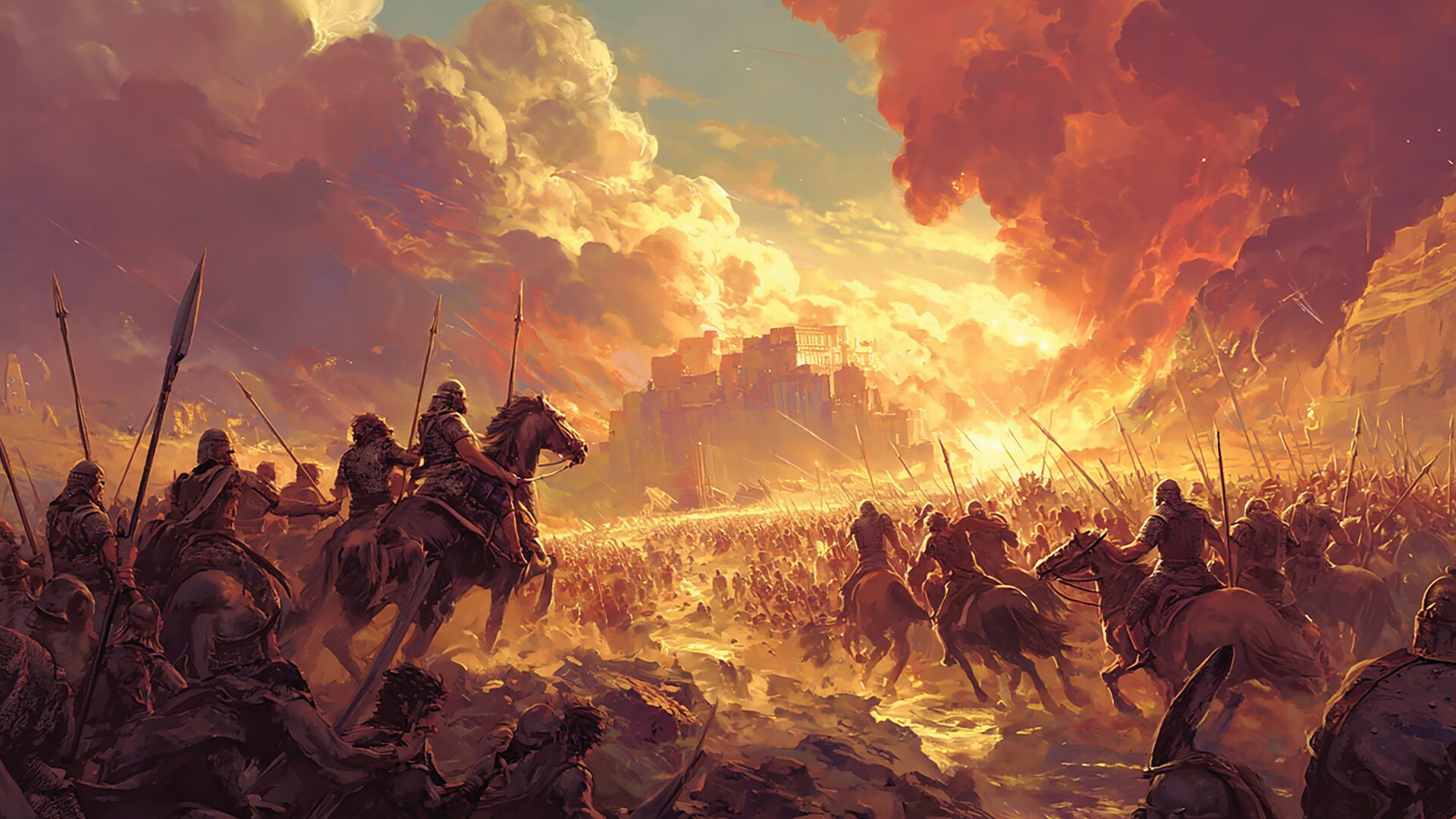
When it comes to ancient Israel’s conquest of Canaan, it is important to make the correct interpretive adjustments that take genre and figures of speech into account. Understanding how things were communicated in the ancient Near East (ANE) sheds light on our understanding of the Bible. Research reveals that hyperbole was very much a feature of the ANE war genre. For example, when Tiglath-Pileser I, King of Assyria, recorded his victories, he claimed to have raided the area from Suhi to Carchemish in one day.2 The distance between these two locations is over 500km! He could not have travelled that distance in one day, let alone raided it. When Pharaoh Merneptah attacked the Levant, he claimed, “Israel is laid waste, his seed is not.”3 King Mesha of Moab also recorded, “Israel perished forever.”4 Both kings were obviously exaggerating their decisive victories over Israel, as neither one of them annihilated Israel (literally).
It is no surprise that the biblical text records warfare in a similar way. Reading it literally without adjusting for exaggeration creates contradictions in the text. For example, how can Jeremiah say that Moab will be destroyed from being a people and then a few verses later declare that Moab will be restored (Jeremiah 48:42,47)? When we examine the Canaanite conquests, the same adjustment needs to be made to harmonise all the verses. For example, God promised to annihilate the Amalekites, and two verses later, Moses interprets that to mean that God will wage war with them from generation to generation (Exodus 17:14,16). Indeed, the Amalekites pop up time and time again throughout the history of Israel after being “annihilated” many times over (eg. 1 Samuel 27:8,9). Other examples of hyperbole include Deuteronomy 7:2, where it says that the Israelites were to annihilate the Canaanites, and yet in the very next verse, God forbids them to intermarry with them. One cannot marry a dead person. Joshua 10:20 says that the Israelites killed the Amorites until they were consumed, yet there were survivors who escaped. Joshua 10 also records how Joshua annihilated the people of Hebron, Debir and Gaza, yet the next chapter reveals that there were people still living there (Joshua 11:21,22). At one point, it records that Joshua took the whole land according to all that God had commanded (verse 23), yet two chapters later, God tells Joshua that there is still a lot more of Canaan to be possessed (Joshua 13:1). Moving forward in time from the Canaanite conquest, we see that hyperbole was still a feature of the war genre. During the civil war in ancient Israel, it was commanded that all the men, women and children of Jabesh-Gilead be slain. However, the next verse interprets what was really meant by that command, and it did not include everyone, certainly not the children (Judges 21:10,11). After David killed Goliath, the women sang that Saul had killed his thousands, and David tens of thousands (1 Samuel 18:7). There is no record of the young David having killed anyone other than Goliath up until this point. This makes the record off by a factor of ten thousand if interpreted literally. Yet, this is nothing compared to the figure given for the army of Canaanites that the Israelites fought with during the conquests. Joshua 11:4 records that they numbered like the sand of the seashore. Howard McAllister from the University of Hawaii made a rough calculation of the number of grains of sand on the world’s beaches. He estimated it to be 7.5 x 10¹⁸ grains of sand.5 This makes the biblical record of the number of Canaanites off by a factor of 7.5 quintillion times (if interpreted literally)!
But why did God reject King Saul for failing to annihilate the men, women, children and babies, together with the ox, sheep, camel and donkeys of the Amalekites (1 Samuel 15:3)? The prophet Samuel confronted Saul and said, “why do I hear the lowing of oxen and bleating of sheep (verse 14)?” Out of all the wrongs that one could have committed, failing to kill animals seems trivial. Is there something more going on here? Verse 8 tells us that Saul did fulfil the command to annihilate the Amalekites, yet they resurfaced again as a people. From this, we see that both the command to destroy the Amalekites and the report of the fulfilment of the command use hyperbole, which, as already noted, was common in the war genre of the ANE. Saul basically had a decisive victory over the Amalekites. Verse 12 specifies the actual problem, and it was that Saul had erected a monument to himself. Saul basically took the credit for the victory over the Amalekites. Not only that, he made their king, Agag, a vassal. In the ANE, once a treaty was ratified, the overlord would typically erect a monument in the territory to glorify the overlord king and mark that the region belonged to him. This meant that Saul was going to support the Amalekites so that he could receive a good tribute from them. Essentially, this monument shows that Saul did the opposite of what God commanded and that he glorified himself. This explains why Samuel defines Saul’s sin as rebellion and idolatry (verse 23). Samuel corrected the problem by killing King Agag. He did not kill the animals as they were not the problem.
We have observed that interpretive adjustments are necessary when examining warfare in the Bible. People used figures of speech and exaggerations in similar ways to us today. The obvious fact that God is not xenophobic is confirmed many times. For example, Joshua blessed the Israelites as well as the foreigners who were among them who also followed God (Joshua 8:35). Conversely, the same decisive action that was taken to put a stop to the evil propagated by the Canaanites was taken against Israel when they practised the same evils (Joshua 23:16). And if we think that God only gave the Israelites land, Deuteronomy 2:9 tells us that God gave land inheritance to the other nations too. Also, Amos 9:7 tells us that God not only delivered Israel out of Egypt but also the Philistines from Caphtor and the Syrians from Kir.
Noticing hyperbole in biblical warfare accounts does not imply that the entire Bible should be read figuratively. Careful attention to genre is crucial. For example, the creation of this world is expressed poetically in the Psalms. It is presented very differently in Genesis, which bears all the genre markers of literal historical narrative.
So why did the Canaanites need to be subdued? Unfortunately, they practised a lot of evils, which included ritual physical and sexual abuse. They even sacrificed babies to their pagan gods. God mercifully waited for the Canaanites to change before taking decisive action against them (Genesis 15:16). Rather than being genocidal, Israel had a reputation for being merciful (1 Kings 20:31). Just as cancer needs to be stopped before it spreads, God was obligated to put a stop to their evils. If He did not, God would be guilty of negligence, and true love is not negligent. Ironically, the same people who mischaracterise God as bloodthirsty reject Him due to the presence of evil in this world. In their mind, God cannot exist because He judges people harshly, yet they simultaneously claim that God cannot exist because, if He truly did, He would take action against evil. Adding to this paradox is the claim that the categories of good and evil themselves are merely subjective human constructs.6
Upon closer examination, we see that God did not order genocide. The Bible is the word of God in human language. Literary genres and figures of speech must be taken into account if we are to interpret God’s Word correctly. Once this is done, we see that the God of the Bible is abundant in mercy and takes the difficult and necessary measures needed to stem the tide of evil. This is exactly what true love does.
- The warnings of Jesus in the Gospels and the Revelation of Jesus Christ reveal that the limited and local judgements of the OT are much greater in the NT in that they are global in scale and eternal.
- The Annals of Tiglath-Pileser I (1,100 BC).
- Merneptah Stele (1,200 BC).
- Mesha Stele (840 BC).
- <https://web.archive.org/web/20120222113647/http://www.hawaii.edu/suremath/jsand.html>
- E.g. “The universe . . . (has) no design, no purpose, no evil, no good, nothing but pitiless indifference.” —Richard Dawkins, River Out of Eden: A Darwinian View of Life (1995), 95.
Emanuel Millen is a lecturer in Biblical Studies at Avondale Seminary.