1.“Their wine is the poison of dragons, and the cruel venom of asps.” (Deuteronomy 32:33, KJV)
“Dragons” are translated as “serpents” in most modern translations. The Hebrew word tannin can refer to either a serpent or a dragon, which are sometimes portrayed as either cunning or chaotic.
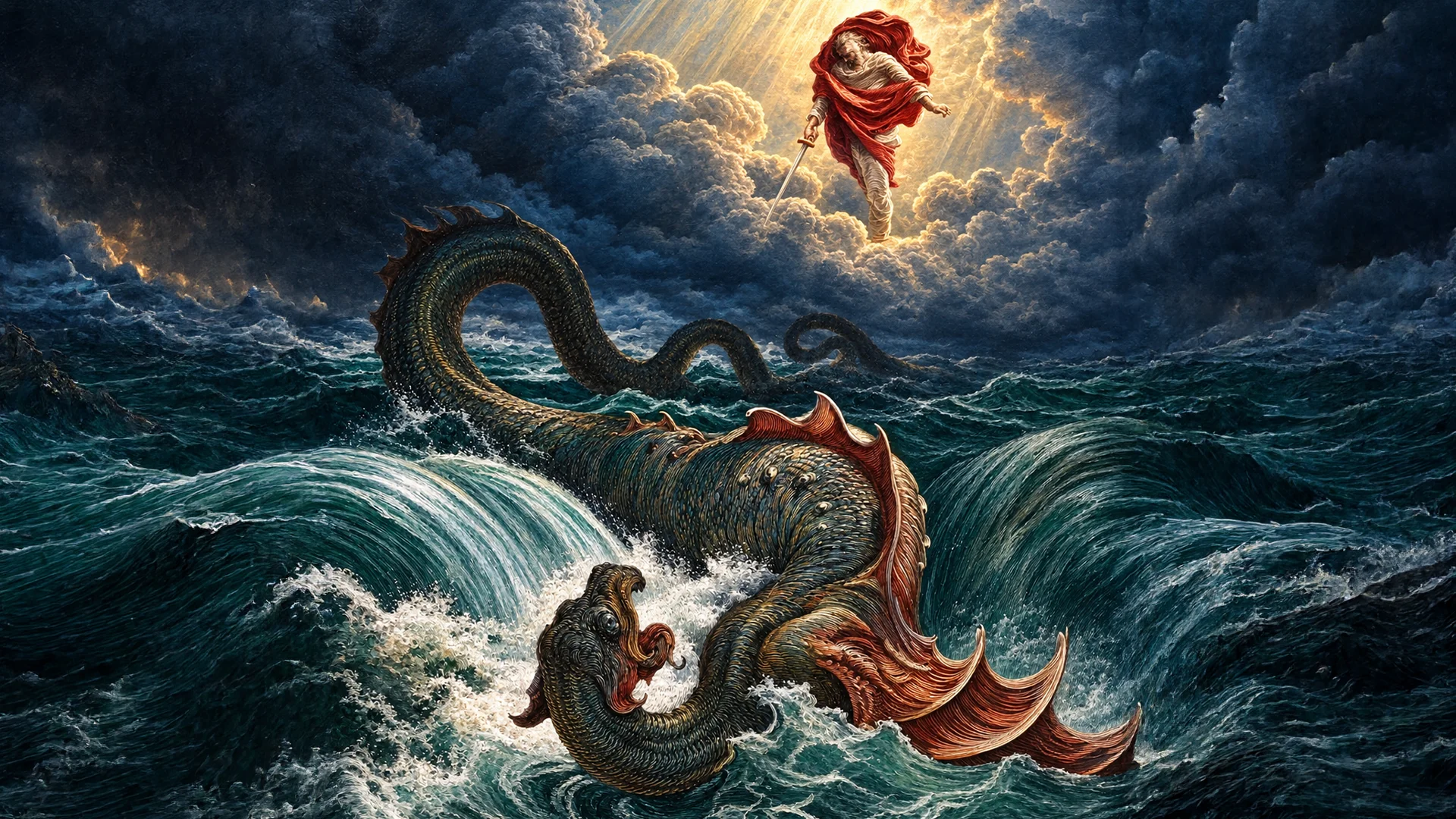
2. “In that day, the Lord will punish with his sword—his fierce, great and powerful sword—Leviathan the gliding serpent, Leviathan the coiling serpent; He will slay the monster of the sea.” (Isaiah 27:1)
Leviathan in the Old Testament is a creature of chaos, often portrayed as in opposition to God’s good, created order. Such portrayals are echoes of Canaanite mythology of the dragons Lotan, Rahab or Yam. Ultimately, Leviathan is subordinate to, and defeated by, God.
3. “And the wild beasts of the islands shall cry in their desolate houses, and dragons in their pleasant palaces: and her time is near to come, and her days shall not be prolonged.” (Isaiah 13:22, KJV)
A translation error that frequently occurs throughout the Hebrew Bible translates the Hebrew word tanim as “dragon” when, based on context and the fact that the Hebrew word for “jackal” is tan, the author clearly meant “jackal”.
4. “Am I the sea, or the monster of the deep, that you put me under guard?” (Job 7:12)
Here Job complains to God because of the catastrophies he has suffered. Is he, Job demands pointedly, a chaos dragon of the deep, that God is threatened by him?
5. “Even the sea monsters draw out the breast, they give suck to their young ones: the daughter of my people is become cruel, like the ostriches in the wilderness.” (Lamentations 4:3, KJV)
Another humorous, albeit disturbing, example of the mistranslation of tanim as “dragon, sea monster”. Modern translations correctly render tanim as“jackal”, sparing the reader from imagining a breastfeeding dragon.
6. “So God created the great creatures of the sea and every living thing with which the water teems and that moves about in it . . .” (Genesis 1:21)
Here, the tannin are not opposed to God, but are part of God’s good created order.
7. “Praise the Lord from the earth, you great sea creatures and all ocean depths.” (Psalm 148:7)
Here, the tannin do not constitute a threat to God, but are summoned to praise God, alongside the “heavenly hosts”, celestial bodies—and even the lightning and hail.
8. “Speak to him and say: ‘This is what the Sovereign Lord says: ‘I am against you, Pharaoh king of Egypt, you great monster lying among your streams.’ You say, ‘The Nile belongs to me; I made it for myself’.” (Ezekiel 29:3)
Frequently, biblical tyrants are portrayed as serpentine or draconic. Here, Pharaoh is compared to a sea monster jealously guarding its hoard. Pharaoh also boasts about creating the Nile—an act only God is capable of.
9. “I am sending you out like sheep among wolves. Therefore be as shrewd as snakes and as innocent as doves.” (Matthew 10:16)
Here, Jesus uses the Greek word ophis, which most commonly is translated “snake”. Though not technically a dragon, the word does have links to the serpent in the Garden of Eden, as well as our final example.
10. “He seized the dragon, that ancient serpent, who is the devil, or Satan, and bound him for a thousand years.” (Revelation 20:2)
The ultimate dragon in the Bible is the devil. Here John describes him as both an ophis, as well as a drakonta (a word only used in Revelation). Though great and terrible, like the dragons in the Old Testament, as well as those of ancient near-eastern myth, this dragon is ultimately subdued and defeated by God. The dragon’s reign of terror is ended and God’s good order overcomes the chaos waters forever.