In my lifetime I’ve been affected by two wars. The first one took place in heaven (Revelation 12:7) many centuries ago and, like everybody else, I’m still reeling from that tragedy. The second war was World War II, five years of great turmoil to which I had a front seat while living in The Hague, the Netherlands.
Today, nearly 60 years later, I remember standing with my mother at the front door of our house to see the first German troops march along our street. Even as a five-year-old I didn’t like this interference with my life. First, armed enemy soldiers roamed the streets. Then coupons were needed to buy food. Next came a curfew. Then Jewish neighbours started to disappear, either by going underground, but more likely taken to a German concentration camp.
Coming home from school one day I found my mother in tears and a Gestapo officer waiting for me, seated on my father’s chair. He clamped me between his massive thighs and accused me of being a saboteur. I never did find out who up-ended the 40-gallon drum and spilled the oil, but it wasn’t me. There was nothing to confess and he left, heaping sinister threats on us—which kept us on tenterhooks for months. On another occasion two soldiers set an unleashed Alsatian dog on me.
Then, as Adolf Hitler wanted to build his Atlantic defence wall, all the western suburbs were evacuated. My family was forced to move to a Roman Catholic area in The Hague East, far removed from the beach and my friends.
Later in the war, the Nazis stole everything from the exasperated Dutch, including trains, food, artworks, cattle and even bicycles. But their most resented act was stealing young men. Without warning, German soldiers would round up all males between 16 and 40 years of age, even dragging them out of their homes. No suitcases, no goodbyes, but, “Schnell, schnell!” on the truck and off to some dreadful German labour camp. Sometimes such round-ups were anticipated. My father hid for many weeks in the underground engine room of a swing bridge and successfully avoided deportation.
Last of all, food and fuel ran out and people started to look skeletal—some staying alive only by eating tulip bulbs (I ate them too—definitely rank). The winter of 1944-45 was the coldest in memory. To survive we burned our solid-timber cupboard doors, stair-treads and shelves to keep warm. Even so, many perished of cold and hunger.
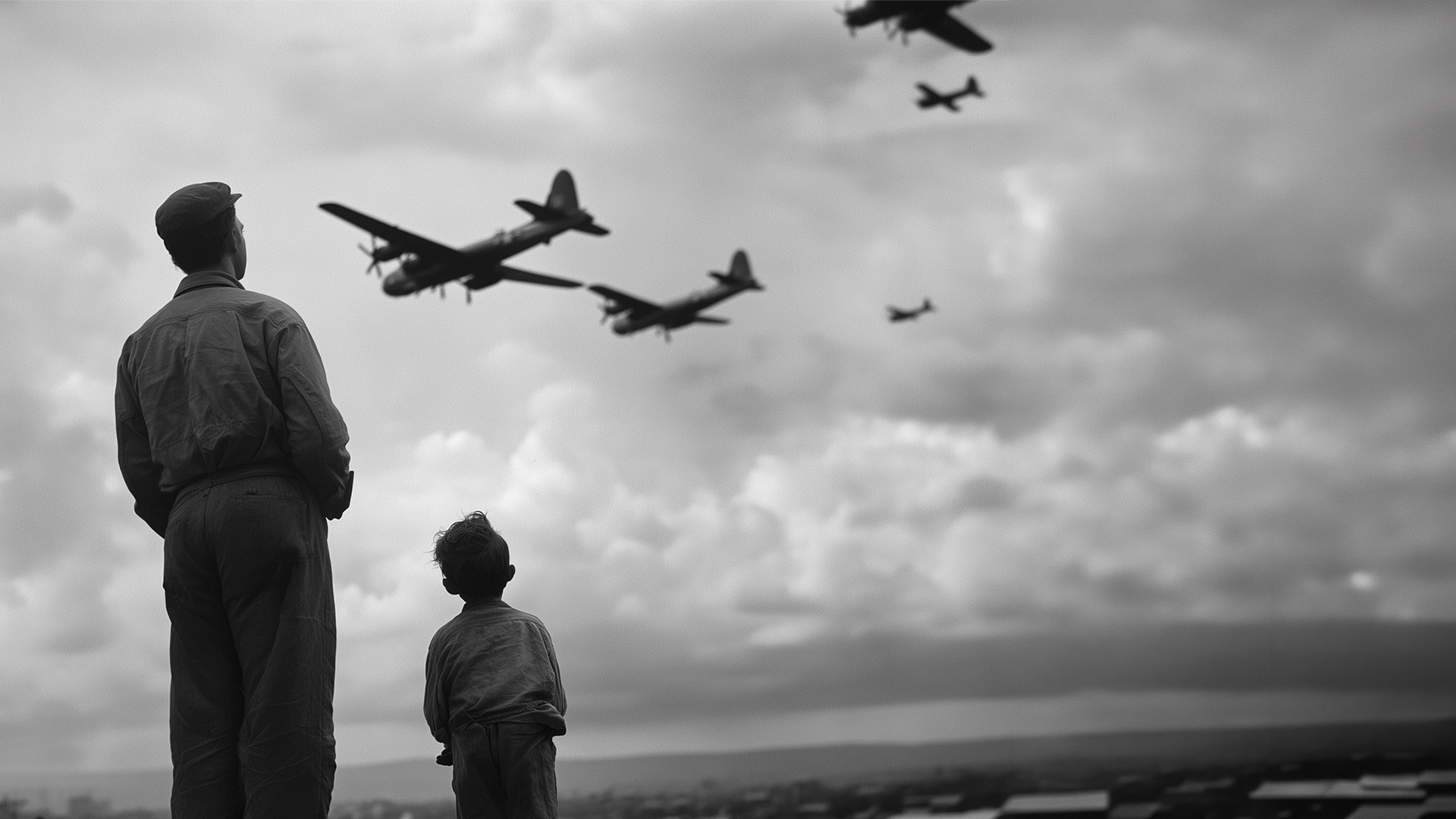
Then, in March 1945, when we were despairing that the war would never end, Hitler rubber-stamped an Eisenhower demand for Allied food drops over The Hague to alleviate the famine. One day in April 1945 I heard this strange, distant rumble coming closer and closer. Seconds later my dad and I were standing on the rooftop, looking up in awe at several lumbering B-29 aircraft—a star painted on their side identifying them as American. They were flying extremely low, and we could clearly see the crew members in the cockpit of one that passed perhaps only 60 metres away from us. The aircraft were dropping desperately needed food over the local airport.* Choked with emotion, I grasped my father’s hand and looked up at him to express my joy and wonderment. It was the only time I’ve seen tears in my father’s eyes. Then, to add to my excitement, the pilot noticed our wild waving on the rooftop and quickly waved back at us with a big Yankee grin.
I sometimes dwell on this once-in-a-lifetime experience and think of the immense joy of “meeting” my liberator in the air so many years ago. I try to relate it to the anticipated and enduring joy when the next person I see bringing deliverance from above won’t be an American in a bomber, but the Lord Jesus on a cloud (Revelation 1:7). Was my experience in 1945 a tiny foretaste of this far more stupendous event? I believe so, and I’m inclined to think that if a transient US pilot could bring tears of joy to my eyes, the second coming of Jesus would have my eyes cascading tears in unadulterated happiness. May He come very soon!
*This life-saving food drop was called “Operation Manna” by the US Air Force.
Taken from June 20, 1998 Adventist Record.