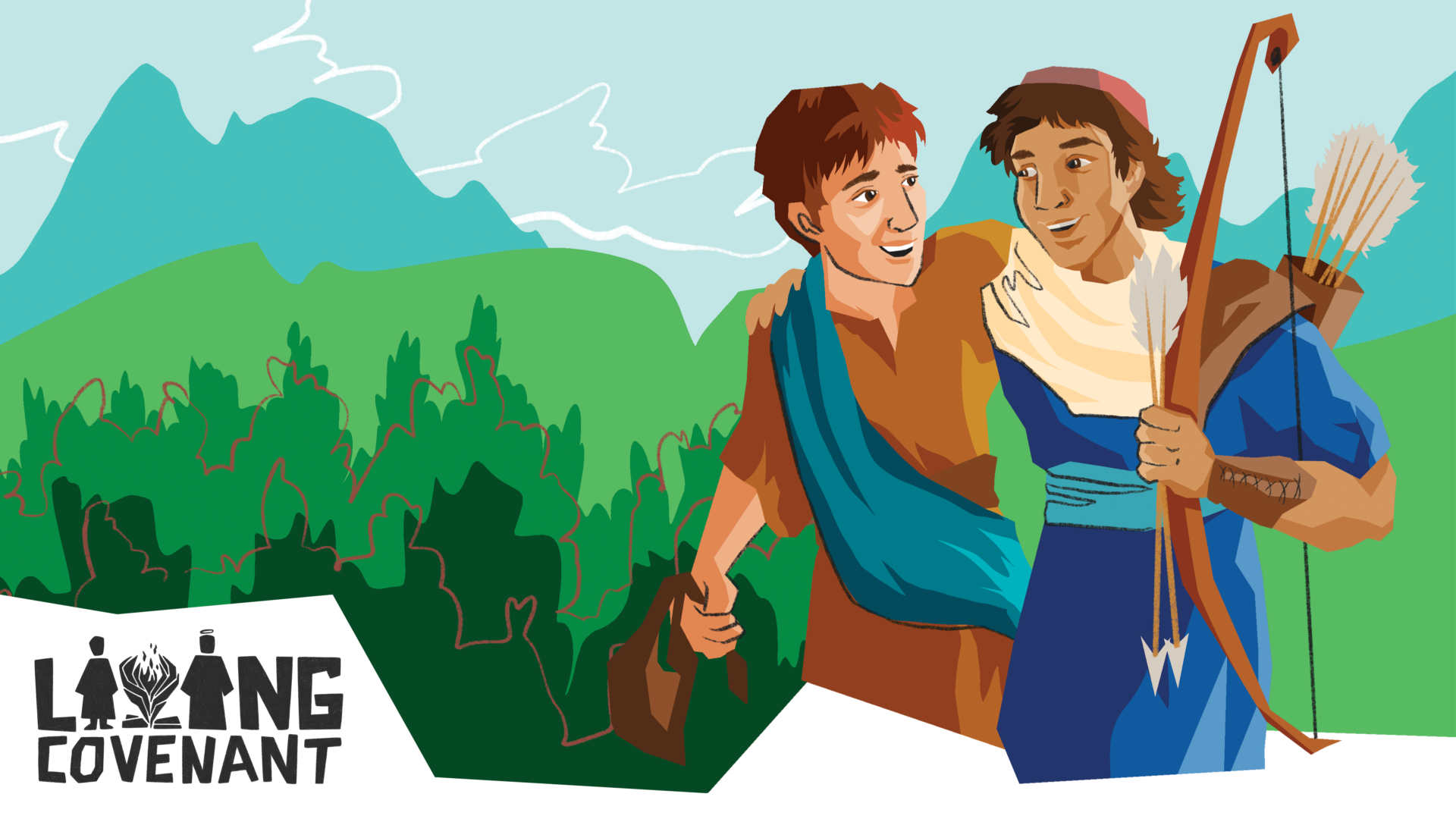
The story of David and Jonathan is a classic. Jonathan’s story pivots around David’s for the majority of 1 Samuel. David is the protagonist, and Jonathan is the best friend who ultimately gives his life for a greater cause. The heartbreak of Jonathan’s sacrifice is placated by the satisfaction of the beloved hero surviving and becoming king.
Sounds like the plotline of half the books I’ve read in the past five years.
But there’s more to this story—it’s part of a greater story: the plan to save humanity. It starts with a God willing to cut a covenant with His people. The Old Testament is full of this ancient Near East practice of forming binding agreements between parties. Often used between countries, a God who cuts covenants with His people wasn’t seen as normal—especially since each time humanity broke the covenant and turned away from God, He still came to the rescue. Starting with Noah, Moses and then Abraham, God bound Himself to us; it was the start of the story of salvation, not to be fulfilled for thousands of years.
Today a covenant is seen as a sacred promise—often used in the context of marriage, an agreement under God to bind yourself to another for life. But what about friendship? Jonathan cut a covenant with David in a very significant move that would define the outcome of his and his descendants’ lives.
Jonathan, the crown prince of Israel, was a remarkable man. We first get a glimpse of his character when he and his armour bearer single-handedly snuck into the Philistines camp and caused a panic. “The Lord has given them into the hand of Israel,” he said (1 Samuel 14:12). The crown prince showed more loyalty to God than his father. He was loved by his people, and he probably would have been a great king. Maybe he even wanted to be king. But that was not in God’s plan, and Jonathan accepted it.
David was just a shepherd boy from Bethlehem, a town in the south of Judah, far from the political and military seat of Gibeah, where Saul held the throne. He first entered the king’s court as a simple musician, but his defeat of Goliath set him down the path God had laid out for him, and he was promoted in status and rank. It was also where his friendship with Jonathan really began.
1 Samuel 18:1 says, “Jonathan became one in spirit with David, and he loved him as himself.” But going further, “Jonathan made a covenant with David. . . [he] took off the robe he was wearing and gave it to David, along with his tunic, and even his sword, his bow and his belt” (v3).
This might seem strange. When I’ve become good friends with people I haven’t offered them the clothing off my back, but this has extreme cultural significance in ancient Israel. Clothing was a sign of status and granted authority to the wearer. Jonathan was ranked one of the highest in the country—David was a lowly shepherd. For Jonathan to strip off his clothing and weapons meant he was surrendering his position as crown prince. He must have known that David would take the throne and not him, and he bowed to God’s will and bound himself to the future king. It was a remarkable move—not only did he step aside and not fight for his place as king, but he befriended David and loved him like a brother.
Jonathan spends the next several chapters of the Bible defending David from his own father. He swears to protect David at any cost, and cuts another covenant with him, swearing loyalty and acknowledging God’s presence in his life. “Show me unfailing kindness like that of the Lord as long as I live, so that I may not be killed, and do not ever cut off your kindness from my family—not even when the Lord has cut off every one of David’s enemies from the face of the earth” (1 Samuel 20:14,15).
The last recorded time that Jonathan saw David he was telling him to escape. They wept with each other, and Jonathan’s last words to David were, “Go in peace, for we have sworn friendship with each other in the name of the Lord” (v42). We don’t know if they ever saw each other again and Jonathan died in battle with his father (1 Samuel 31). David writes a lament, singing, “How the mighty have fallen in battle! Jonathan lies slain on your heights. I grieve for you, Jonathan my brother; you were very dear to me” (2 Samuel 1:26).
Jonathan’s legacy was lost in his father’s rejection of Yahweh. Yet his descendants survived, due to the covenant he cut with David. God rejected Saul’s house, yet Jonathan stayed true to God, and his yielding of the throne and protection of David showed both his loyalty to God and the strength of his friendship with the anointed king.
Jonathan is not mentioned in the Bible beyond Chronicles. He’s not heralded in the Hebrews’ hall of faith—it’s David who’s heralded as the hero, because Jonathan put him before he put himself.
Have you had a friend like that? Have you been a friend like that?
I’ve been very fortunate with the good friends I’ve found throughout my life. Unfortunately, many are scattered across the globe as I’ve moved around a fair bit and left people behind. I’ve often felt lonely, and it’s hard knowing that some of the people I love most in the world are an ocean away. Like Jonathan, I’ve had to say goodbye, though with much lower stakes.
One such friend I’ve known for many years. We’ve been through much together, and have shared many good memories, yet our friendship has had challenges. She’s hurt me before, lashing out for little reason other than past, unresolved pain. Does that give me leave to cut her out of my life? Or do I forgive her?
I’ve been thinking about friendship and what it means to be a good friend. Social media loves to pick apart friendships, going into great detail about frenemies, toxic friends and the like. I’ve noticed that people are now very quick to label someone as toxic and cut them out of their lives.
There is, of course, a place for this. Sometimes friendships can be very unhealthy, and having boundaries in place is incredibly important. Yet there is something to be said for sticking by your friends despite their faults. I have to wonder, if in this world of perfectly curated online domains, we are also expecting our friends to be perfect, and if they don’t reach that standard, we cut them out of our lives instead of extending grace.
What does it mean to stick by a friend? What does it truly mean to be a friend? When I think about our individualistic and self-centred society, I wonder if we’ve lost what it means to pledge love to someone, platonic or not, and hold to that promise.
In a covenant between a higher and lower power, the lower power bore the brunt of the consequences when that covenant was broken. Yet God knew we would break the covenant He made with humanity, and He had a plan—Jesus, our greatest Friend, bore the consequence instead of us. And as a result we have a future that doesn’t include pain, suffering or goodbyes.
Jonathan reminds me of Jesus. Jonathan submitted to David; Jesus submitted to humanity. They laid down their crowns for those they loved. John 15:3 says, “Greater love has no one than this: to lay down one’s life for one’s friends.” In today’s world we probably won’t find ourselves in situations where we will literally have to lay down our lives for our friends, but in a world that tells us to care only about ourselves, Jonathan’s life is an example of a different way.
While Jonathan may not be considered a great hero in the Hebrews hall of faith, he’s one of mine. He was a humble person who demonstrated extraordinary love and kindness. His story challenges me to ask myself if I’m willing to be like him. He has shown me what it means to forgive my friend, to love her, to be kind and show empathy in a cruel world—and also, to ask the most important question: am I willing to be like Jesus?
Ashley Jankiewicz is an assistant editor for Adventist Record.