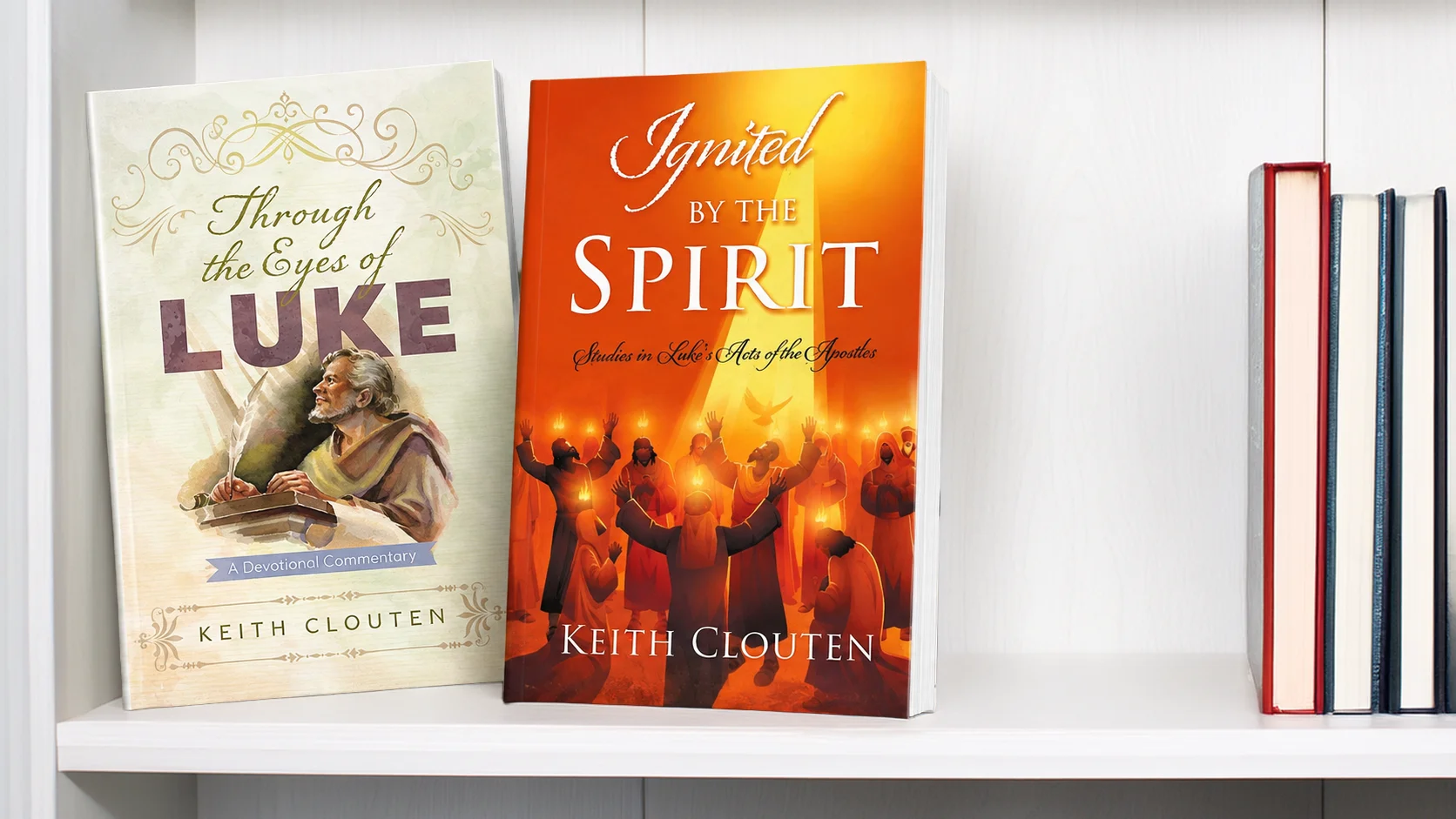
A librarian by profession and an Australian by birth, Keith Clouten has served at Adventist universities and colleges around the world and is now retired in Alberta, Canada. He has published a number of books and talked recently about his books on the New Testament writings of Luke.

Why do books matter to you?
A love of books, reading, and writing dates from my early years at elementary school. My favourite class was “Composition and Writing Essays.” Later, as a student at Avondale College, I loved and valued books as a source of learning and knowledge about the world. This soon transitioned into library employment, beginning as Avondale’s first library director. After acquiring a library degree from University of Southern California, I practised professionally at what is now Burman University in Canada, moving on to Director of Libraries at Andrews University until retirement in 2003.
How do you decide what you write about?
While living in Australia, I wrote my first books on secular topics: a well-researched volume on regional history (1967), and a book about my backpacking adventures in and around the Hunter River Valley (1981). It was many years later, in Canada, at 70 years of age, that I had a clear call from the Holy Spirit to write on spiritual topics.
What has drawn you to the writings of Luke in the two books you have written on the gospel and the Book of Acts?
My interest in Luke as a writer originated when I discovered that Luke, a non-Jew, wrote more of the New Testament than any other writer, including Paul. Amazed, I learned that Luke the Gentile never knew or met Jesus of whom he wrote the longest of the four Gospels. We discovered that Luke resided at Antioch, a Syrian city located north of Palestine. Luke converted to Christianity during visits to Antioch by Peter, Barnabas and Paul.
Though not openly critical of Jews, Luke in his Gospel focused on some attitudes of Jewish leaders which he disliked, including their attitude to those outside their faith (see Luke 4:24–29; 10:30–37), their neglect of women in need, especially widows (see Luke 7:11–17, 18:1–8), their love of wealth (see Luke 12:13–21; 16:19– 31), and their lack of mercy for sinners (see Luke 15).
My study of Luke’s second book, The Acts of the Apostles, highlighted other aspects of Luke’s character as a writer. One that stands out is his choice of the individuals who were involved in the development of the early Christian Church. Despite the book’s name, which suggests it records the work of the 11 “apostles”, only two of them—Peter and John—get Luke’s attention. These were the only two Luke ever met. In place of the apostles, Luke chose men of the Jewish Diaspora (dispersion), those born outside of Jerusalem and Judea, including Barnabas, Philip and Paul, who was also a Diaspora Jew born in Tarsus, Silicia. All this tells me that the early church history authored by any other apostle would read differently compared with Luke’s story.
Describe the approach you take in these devotional Bible-study books.
The typical commentary on Luke or Acts takes up the story in lengthy chapters. Led I believe by the Holy Spirit, my approach breaks the story into dozens of short chapters, each having a devotional approach with summary questions for the reader.
What has grown in your understanding of these parts of the Bible in the course of your writing?
Studying and writing about Luke’s Gospel and Acts has opened my mind and heart to a passionate love of these Scriptures. Quoting from my preface to Ignited by the Spirit: “I think of Luke’s Gospel and Acts as theory is to practice. In the first, we see how Jesus lived sacrificially for us. In the sequel, we learn how we can live sacrificially for others. The secret is having a living relationship with Jesus Christ, who is still at God’s right hand releasing the Holy Spirit to anyone seeking spiritual improvement.” Ignited by the Spirit and Through the Eyes of Luke are available now from Adventist bookshops in Australia and New Zealand, or online.