Nestled in the heart of Andrews University, Michigan, USA, the Centre for Adventist Research (CAR) stands as one of the most significant collections of Seventh-day Adventist history in the world.
For church members in the South Pacific Division—where the Adventist story has flourished across diverse cultures and islands—the work of CAR provides a vital bridge between our shared past and a faithfully rooted future.
Established in the 1960s, CAR originated as a collaborative effort among the James White Library, the Department of Church History and the Ellen G White Estate Branch Office at Andrews. It has evolved into a dynamic research centre and archive dedicated to preserving, organising and sharing Adventist stories globally.
Today, the collection is vast: more than 50,000 books and pamphlets, over 30,000 periodical issues, thousands of original letters, photographs and rare documents, plus an extensive audiovisual collection—with special emphasis on early pioneers, including Ellen and James White, JN Andrews and others who helped shape our movement.
But more than names and dates, CAR’s mission is clear—to preserve Adventist identity and mission by safeguarding its historical memory. Our local Pacific stories—whether from Australia, Fiji, Kiribati, New Zealand, Papua New Guinea, Samoa, Solomon Islands, Tonga, Vanuatu or beyond—are part of this broader Adventist heritage. The centre actively continues to collect stories, original documents, photographs and records from around the world.
In a time when digital access is transforming research, CAR is digitising key documents for free online access. A young church member in Honiara or Suva can read original tracts from the 1800s, browse Ellen White’s scanned letters or listen to vintage sermons—all from home. This matters because a church that forgets its past risks losing its purpose. Our pioneers faced economic hardship, social opposition and cross–cultural mission challenges—struggles that mirror ours today. Their courage, resilience and commitment can inspire our mission now.
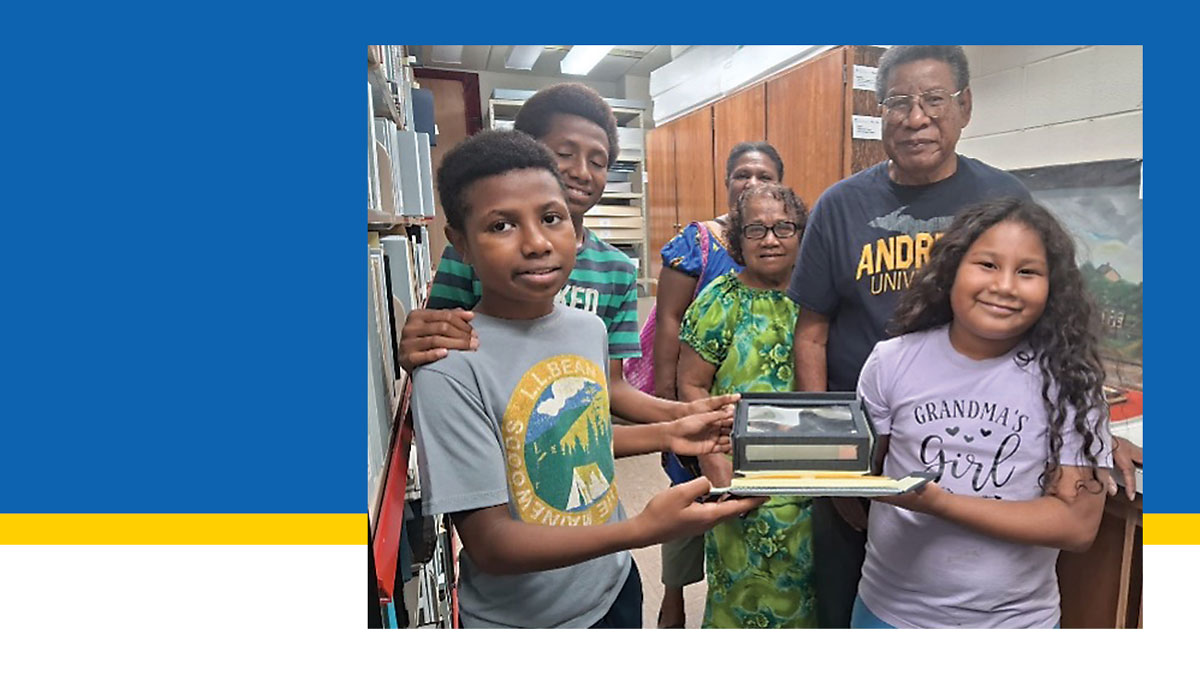
This truth came into sharp focus on August 7, when I had the privilege of taking Pastor Tony Kemo and his wife, Beatrice, their granddaughter (Maya) and my family for a visit to CAR.
Both retired, the Kemos are etched into the history of the Adventist movement in Papua New Guinea and across the South Pacific. Pastor Kemo served for decades in various leadership roles, championing evangelism, pastoral training and mission expansion. Mrs Kemo has inspired many through her leadership in women’s ministries, community outreach and prayer ministry.
As we walked through the archival rooms, the couple’s faces lit up at the displays: JN Andrews’ travel trunk, Uriah Smith’s desk, papier–mache beasts from early prophetic evangelism and the illuminated model of Nebuchadnezzar’s statue from Daniel 2.
In the secure vault—home to Ellen White’s original manuscripts, rare books, historical artefacts and other special collections—they were awestruck by the privilege of viewing these irreplaceable documents. For the Kemos, this was more than an academic visit—it was a deeply personal and spiritual homecoming.
“Preservation of our Church’s history is essential for future generations,” Pastor Kemo reflected. “Without it, we risk losing the memory of how God has led us.” Mrs Kemo added, “Our young people need to know this history—it will give them courage to keep the mission alive.”
In the South Pacific, our heritage includes stories of the first missionaries arriving by canoe, early Sabbath keepers under a mango tree and young people walking miles to attend Bible studies. These are not simply inspiring tales— they are part of our theological and missional identity.
As Ellen White wrote, “We have nothing to fear for the future, except as we shall forget the way the Lord has led us, and his teaching in our past history” (Life Sketches, p196).
By cherishing and preserving our Church history, we equip future generations to build on the faith and vision of those who came before—ensuring that our past continues to illuminate our future.
Peter Ohura Korave is a PhD student in Religious Studies at Andrews University.